
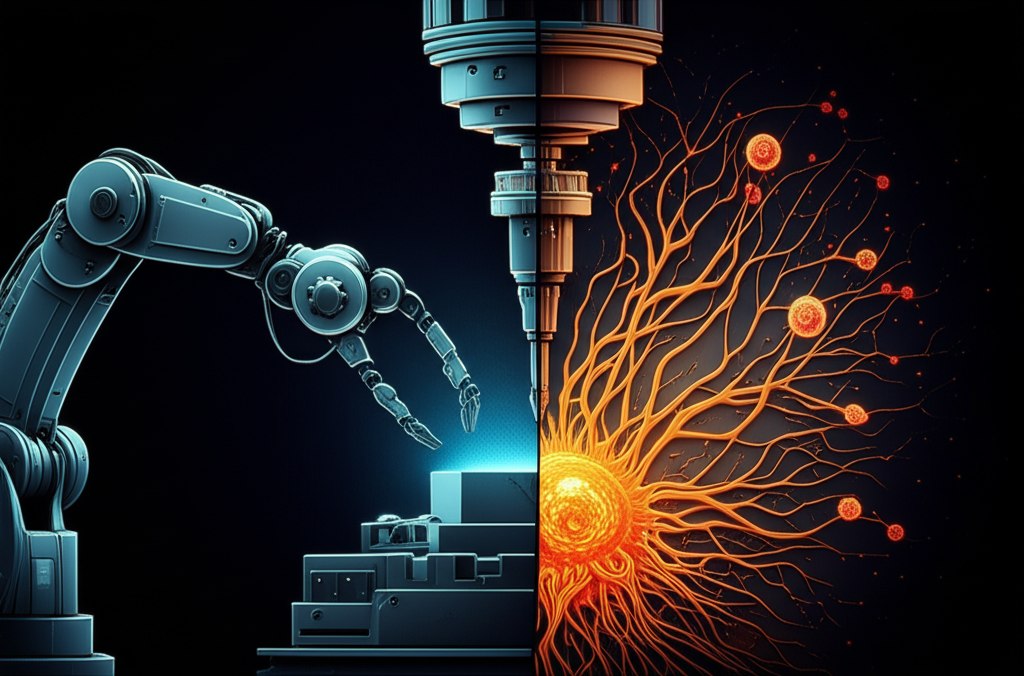
Assembly vs Growth: The Fundamental Divide Between Robots and Life 🤖🌱
How two fundamentally different approaches to building complex systems reveal why artificial intelligence may never truly replicate biological intelligence.
Consider a robot being assembled in a factory. Each component has precise specifications - bolts with exact diameters, motors with defined torque ratings, sensors with calibrated sensitivity. The assembly process follows a predetermined sequence, with each step building upon the previous one in a linear, predictable manner. The final robot emerges fully formed, its capabilities fixed from the moment of completion.
Now consider a seed. Microscopic, seemingly simple, yet containing the potential for an entire tree. It doesn't assemble into a tree through discrete steps with predefined values. Instead, it grows, adapts, and develops in response to its environment. The same seed can become a stunted shrub in poor soil or a towering oak in rich earth. Its final form isn't predetermined but emerges through continuous interaction with its surroundings.
This fundamental difference between assembly and growth reveals why artificial systems, despite their impressive capabilities, may never truly replicate the complexity and adaptability of biological systems.
The Discrete Nature of Assembly 🔧
Robotic assembly operates on discrete values and predetermined specifications. Every component has exact tolerances, every connection follows a precise protocol, every function is programmed with specific parameters. This approach has undeniable advantages:
- Predictability: We know exactly what we'll get
- Consistency: Every robot of the same model performs identically
- Efficiency: Assembly can be automated and optimized
- Reliability: Components can be tested and validated individually
But this discrete approach also creates fundamental limitations. The robot's capabilities are fixed at the moment of assembly. It cannot grow new sensors, develop new limbs, or fundamentally change its structure in response to changing needs. It's a static system in a dynamic world.
The Adaptive Nature of Growth 🌱
Biological growth operates on entirely different principles. A seed doesn't contain a blueprint for a specific tree - it contains the potential for many possible trees, with the final form emerging through continuous interaction with the environment.
Consider how a plant grows:
- It doesn't assemble leaves and branches according to a fixed plan
- It grows in response to available light, water, and nutrients
- It can redirect resources to different parts based on need
- It can repair damage, replace lost parts, and adapt to changing conditions
This adaptive growth creates systems that are:
- Resilient: They can recover from damage and adapt to changing conditions
- Efficient: They only grow what they need, when they need it
- Complex: They can develop intricate structures that would be impossible to design from scratch
- Sustainable: They work with available resources rather than requiring specific inputs
The Significance of Starting Small 🌱
Perhaps the most profound difference lies in the starting point. Robots begin as complex assemblies of sophisticated components - motors, sensors, processors, all requiring precise manufacturing and careful integration. Life begins as something almost unimaginably simple - a single cell, or even just a collection of molecules.
This difference in starting conditions has profound implications:
Robots require infrastructure: They need factories, supply chains, quality control systems, and skilled technicians. They can only be built where this infrastructure exists.
Life creates its own infrastructure: A seed can grow in almost any environment, creating the structures it needs from simple materials. It doesn't require external manufacturing capabilities.
This explains why life has colonized nearly every environment on Earth, while robots remain confined to controlled, human-maintained environments.
The Challenge of Artificial Growth 🌱
Attempting to create artificial systems that grow rather than assemble presents unique challenges. How do you program adaptability without losing control? How do you ensure the system grows in useful ways rather than becoming chaotic or destructive?
Current approaches to artificial intelligence and robotics still rely heavily on assembly principles:
- Neural networks are "trained" with fixed architectures
- Robots are designed with specific capabilities in mind
- Software systems are built with predetermined functionality
Even when these systems can learn and adapt, they do so within the constraints of their original design. They can't fundamentally change their structure or develop new capabilities that weren't anticipated by their creators.
The Promise of Hybrid Approaches 🔄
The most promising developments may come from combining the precision of assembly with the adaptability of growth. Imagine robots that can:
- Grow new sensors in response to changing environments
- Develop new limbs or tools as needed
- Repair and modify their own structures
- Adapt their internal organization based on experience
Such systems would represent a new paradigm - not pure assembly or pure growth, but something that combines the best of both approaches.
Implications for Artificial Intelligence 🧠
This distinction between assembly and growth has profound implications for artificial intelligence. Current AI systems are essentially sophisticated assemblies - they're built with specific architectures, trained on specific data, and deployed with fixed capabilities.
True artificial intelligence might require systems that can grow and develop their own capabilities, much like biological brains do. This would mean:
- Starting with simple, general-purpose learning systems
- Allowing them to develop specialized capabilities based on experience
- Enabling them to modify their own structure and organization
- Creating systems that can grow in complexity over time
The Fundamental Question 🤔
The assembly vs growth distinction raises a fundamental question: Can we create artificial systems that truly grow and adapt, or are we forever limited to building more sophisticated assemblies?
If assembly is the only approach available to us, then artificial systems will always be fundamentally different from biological ones. They may be more powerful in specific domains, but they'll lack the general adaptability and resilience that characterizes life.
If we can develop true artificial growth, we may be able to create systems that rival or exceed biological intelligence. But this would require fundamentally new approaches to system design - approaches that prioritize adaptability over predictability, emergence over control, and growth over assembly.
Conclusion: Embracing the Difference 🌟
Rather than trying to make artificial systems exactly like biological ones, perhaps we should embrace the fundamental differences between assembly and growth. Each approach has its strengths:
Assembly excels at: Precision, consistency, predictability, and optimization for specific tasks Growth excels at: Adaptability, resilience, complexity, and general-purpose capabilities
The future may not belong to systems that perfectly replicate biological intelligence, but to systems that combine the best of both approaches - the precision and efficiency of assembly with the adaptability and resilience of growth.
In the meantime, understanding this fundamental divide helps us appreciate why biological systems remain so remarkable, and why creating truly intelligent artificial systems remains such a profound challenge.
The seed doesn't try to be a robot, and the robot doesn't try to be a seed. Each follows its own path to complexity, and perhaps that's exactly as it should be.