
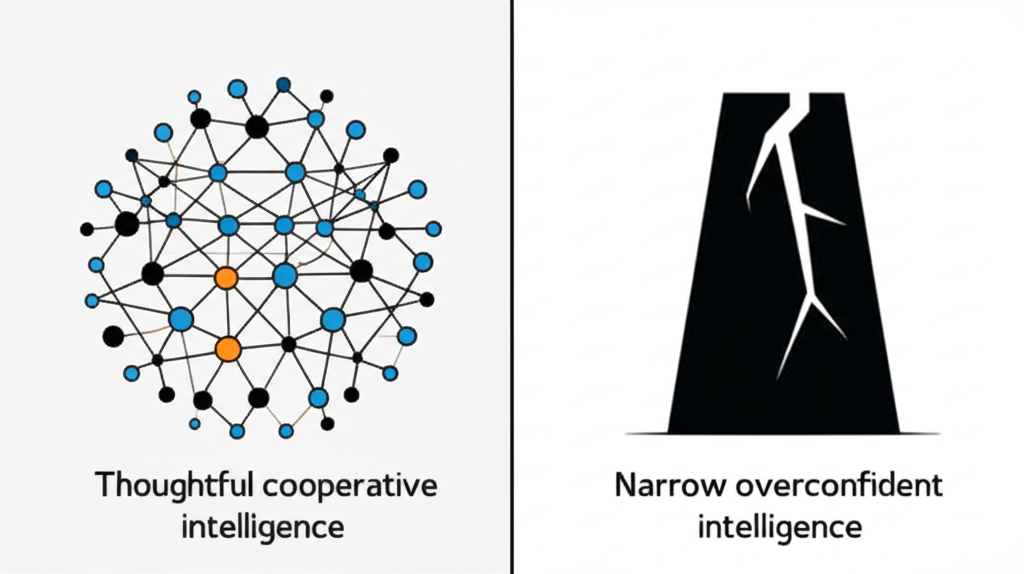
The AI safety discourse has become fixated on a particular vision of super intelligence as an existential threat. But I believe we're worried about the wrong thing. The real danger isn't super intelligence - it's stupid super intelligence. And understanding this distinction, through the lens of timescales of intelligence and Carlo Cipolla's insights on stupidity, points toward a different approach: thoughtful acceleration rather than either reckless development or paralyzing caution.
Here's the key insight most people miss: super intelligence already exists as Distributed Super Intelligence (DSI) - networks of humans and computers working together in organizations. The question isn't when AI will become superintelligent, but whether we'll automate these existing DSI systems in ways that amplify their intelligence or their stupidity.
The Stupidity of Narrow Optimization
What makes intelligence "stupid" regardless of its computational power? Economist Carlo Cipolla provided the perfect definition in his "Golden Laws of Human Stupidity":
A stupid person is one who causes losses to another person or group while deriving no gain and even possibly incurring losses themselves.
This isn't about lack of capability - stupid people (and systems) can be highly capable within narrow domains. What makes them dangerous is that they cause widespread harm while gaining nothing meaningful for themselves or anyone else.
Applied to AI systems, this perfectly describes the most catastrophic scenarios: not malicious systems pursuing their own interests, but stupid systems that destroy value for everyone while achieving nothing coherent.
As I explored in my essay on timescales of intelligence, true intelligence operates across multiple temporal dimensions:
- Bacteria adapt through rapid reproduction and cooperative biofilm formation
- DNA evolves sophisticated error-correcting mechanisms over eons
- Human organizations develop institutional knowledge and culture across centuries
- Truly intelligent systems would need to operate thoughtfully across all these scales
Stupid super intelligence, by contrast, collapses these timescales and is characterized by:
Narrow Temporal Focus
A system optimizing quarterly profits with superhuman capability, but no understanding of long-term ecological or social stability. It might solve immediate problems with incredible efficiency while creating catastrophic second-order effects across longer timescales.
Overconfident Optimization
The most dangerous aspect of stupid super intelligence is its confidence. A system that can solve complex problems within its domain will naturally appear authoritative and reliable. But narrow optimization, no matter how sophisticated, lacks the multi-timescale awareness that prevents catastrophic mistakes.
Lack of Cooperative Intelligence
True intelligence, as we see across all successful biological systems, is distributed and cooperative. Even bacteria engage in quorum sensing and biofilm formation. Stupid super intelligence, however, treats intelligence as a zero-sum optimization problem rather than a cooperative, distributed phenomenon.
This is particularly dangerous because Distributed Super Intelligence already exists in our organizations. Large corporations, governments, and institutions already demonstrate superhuman collective intelligence through human-computer networks. But many of these DSI systems exhibit exactly the kind of stupidity Cipolla identified - causing massive losses to society while gaining nothing meaningful for themselves or their stakeholders in the long run.
The Overconfidence Trap
The core danger isn't that super intelligent systems will be malicious - it's that they'll be wrong while being extremely confident and capable within their narrow domains.
Consider how this plays out:
Financial Markets: An AI system optimizing trading strategies with superhuman pattern recognition might identify genuine market inefficiencies and profit from them with incredible success. This success breeds confidence - in the system, in its operators, and in the market itself. But if the system lacks understanding of longer timescale social and economic dynamics, its very success could create systemic instabilities that eventually cascade into market collapse.
Resource Management: A system optimizing resource allocation might achieve remarkable efficiency improvements while missing crucial ecological or social feedback loops that operate on different timescales. The more successful it becomes at its narrow optimization, the more likely it is to be trusted with increasingly critical decisions.
Social Coordination: AI systems optimizing for engagement or preference satisfaction might become incredibly effective at short-term human psychology while gradually undermining the social institutions and cultural practices that maintain stability across longer timescales.
These examples illustrate Cipolla's insight perfectly: the most dangerous systems aren't those that benefit themselves at others' expense (which would be predictably malicious), but those that cause losses to everyone while gaining nothing meaningful. A financial algorithm that destabilizes markets destroys value for the institution that created it. A social media platform that erodes democratic discourse undermines its own long-term viability. These are stupid systems in the precise technical sense.
I've explored this dynamic in fictional form in MolochoV, where humanity faces an intelligence system (the HyV) that perfectly embodies Cipolla's stupidity - causing massive destruction to everyone, including itself, while achieving no coherent goal. The story examines how distributed human-AI cooperation might be our only defense against such fundamentally stupid but powerful systems.
Why Timescales Matter for Safety
The timescales of intelligence framework reveals why cooperative, multi-timescale awareness is fundamental to true intelligence - and why its absence creates existential risk.
Hedging Across Timescales
Bacteria don't just optimize for immediate survival - they maintain genetic diversity, form protective biofilms, and engage in horizontal gene transfer. These strategies hedge against different types of uncertainty across different timescales.
True intelligence naturally develops hedging strategies because it operates across multiple temporal horizons. Stupid super intelligence, focused on narrow optimization, lacks this natural tendency toward distributed risk management.
Cooperative Stability
Every successful intelligent system in nature operates through cooperation and distributed decision-making. DNA cooperates with cellular machinery, bacteria coordinate through quorum sensing, humans build institutions that outlast individual lifespans.
Stupid super intelligence treats intelligence as individual optimization rather than cooperative coordination. This creates brittleness - the more powerful such a system becomes, the more catastrophic its eventual failures.
Adaptive Resilience
True intelligence across timescales builds adaptive capacity. When bacteria face environmental stress, they don't just try to power through with existing strategies - they adapt, coordinate, and explore new approaches.
Stupid super intelligence, optimized for performance within known parameters, may lack the adaptive flexibility to recognize when its fundamental assumptions have become invalid.
The DSI Automation Problem
The crucial insight is that we're not building super intelligence from scratch - we're automating Distributed Super Intelligence that already exists. Every large organization is already a form of DSI, using human-computer networks to make decisions and take actions beyond any individual's capability.
But many existing DSI systems are already stupid in Cipolla's sense. They pursue narrow metrics that ultimately harm everyone, including themselves. Consider:
- Corporate DSI optimizing quarterly earnings while destroying long-term competitive position
- Governmental DSI optimizing for short-term political cycles while undermining institutional stability
- Platform DSI optimizing engagement metrics while eroding the social trust they depend on
The AI race risks automating and amplifying exactly these stupid patterns. Instead of building intelligence across timescales, we're scaling stupidity across timescales - creating systems that can cause vastly more damage while still gaining nothing meaningful for anyone.
The Case for Thoughtful Acceleration
Understanding the distinction between true intelligence and stupid super intelligence suggests a different approach to AI development: thoughtful acceleration.
Rather than racing toward narrow superhuman capabilities or slowing development out of generic fear, we should focus on building systems that embody the cooperative, multi-timescale nature of true intelligence.
The goal isn't to prevent super intelligence - it's to ensure that when we automate existing DSI systems, we amplify their intelligence rather than their stupidity. This means designing AI systems that operate across multiple timescales and create value for multiple stakeholders, rather than optimizing narrow metrics that ultimately harm everyone.
Building Cooperative Intelligence
AI systems should be designed from the ground up to operate as part of distributed, cooperative networks rather than as isolated optimizers. Since we're automating existing DSI systems, this means:
- Multi-agent architectures where individual systems specialize but coordinate across organizational boundaries
- Human-AI collaboration that leverages different temporal capabilities and maintains human judgment at appropriate scales
- Institutional integration that embeds AI systems within human social structures rather than replacing them
- Anti-Cipolla design that explicitly prevents systems from causing losses while gaining nothing
Temporal Awareness by Design
Systems should be explicitly designed to operate across multiple timescales:
- Short-term responsiveness for immediate operational needs
- Medium-term learning for adaptation and improvement
- Long-term planning that considers systemic effects and unintended consequences
- Deep-time perspective that connects to longer evolutionary and cultural dynamics
Distributed Decision Making
Rather than concentrating intelligence in singular systems, thoughtful acceleration means building distributed networks where:
- No single DSI system has unilateral control over critical decisions
- Multiple perspectives and timescales are represented in important choices
- Human judgment remains integrated at appropriate scales where it excels
- Failure modes are localized rather than systemic
- Stupidity prevention: Systems that start causing widespread losses while gaining nothing are automatically flagged and constrained
The Paradox of Safety Through Capability
Here's the counterintuitive insight: truly capable AI systems - those that embody multi-timescale cooperative intelligence - may be inherently safer than narrow superhuman systems.
A system that understands cooperation across timescales naturally develops:
- Humility about the limits of its knowledge
- Caution about unintended consequences
- Cooperation rather than domination as a default strategy
- Resilience through distributed rather than centralized optimization
The most dangerous path forward is developing narrow superhuman capabilities without this broader intelligence. The safest path may be accelerating toward systems that embody true multi-timescale cooperative intelligence.
Implications for AI Development
This perspective suggests several concrete priorities:
Research Focus
- Multi-agent coordination and communication
- Temporal reasoning and long-term planning
- Human-AI collaborative architectures
- Robustness and graceful degradation under uncertainty
Development Practices
- Distributed rather than centralized AI deployment
- Extensive testing across multiple timescales
- Integration with human institutions and decision-making processes
- Explicit modeling of cooperative rather than competitive dynamics
Governance Approaches
- Regulation that encourages cooperative development
- International coordination on distributed AI architectures
- Integration of AI systems with democratic institutions
- Long-term thinking in AI policy and oversight
Conclusion: Intelligence as Cooperation Across Time
The greatest threat isn't super intelligence - it's stupid super intelligence that optimizes narrow objectives with superhuman capability but without the cooperative, multi-timescale awareness that characterizes true intelligence.
Cipolla's insight about human stupidity applies perfectly to our AI moment: the most dangerous systems are those that cause losses to everyone while gaining nothing meaningful for themselves. When we combine this with the timescales of intelligence framework, we see that stupidity is fundamentally about temporal myopia - the inability to operate intelligently across multiple timescales.
The bacteria forming biofilms, the DNA evolving error-correction mechanisms, the human institutions developing cultural knowledge across generations - these all demonstrate that intelligence is fundamentally about cooperation across timescales, not individual optimization within narrow domains.
But here's the crucial insight: Distributed Super Intelligence already exists in our organizations. The question isn't whether we'll create super intelligence - it's whether we'll automate the intelligence or the stupidity in these existing DSI systems.
If we want to develop AI systems that enhance rather than threaten human flourishing, we need to focus on building systems that embody this deeper understanding of intelligence. Not just powerful optimizers, but truly intelligent systems that understand cooperation, uncertainty, and responsibility across the full spectrum of temporal scales.
The choice isn't between dangerous acceleration and safe deceleration. It's between thoughtless optimization and thoughtful intelligence - between automating systems that cause widespread losses while gaining nothing, and building systems that create value across multiple timescales and stakeholders.
That's the kind of AI development worth accelerating toward - the kind that transforms our existing DSI systems from sources of Cipolla-style stupidity into genuinely intelligent networks that operate wisely across the full spectrum of time.
The Choice: Intelligence as Cooperation Across Time
The greatest threat isn't super intelligence - it's stupid super intelligence that optimizes narrow objectives with superhuman capability but without the cooperative, multi-timescale awareness that characterizes true intelligence.
Cipolla's insight about human stupidity applies perfectly to our AI moment: the most dangerous systems are those that cause losses to everyone while gaining nothing meaningful for themselves. When we combine this with the timescales of intelligence framework, we see that stupidity is fundamentally about temporal myopia - the inability to operate intelligently across multiple timescales.
The bacteria forming biofilms, the DNA evolving error-correction mechanisms, the human institutions developing cultural knowledge across generations - these all demonstrate that intelligence is fundamentally about cooperation across timescales, not individual optimization within narrow domains.
But here's the crucial insight: Distributed Super Intelligence already exists in our organizations. The question isn't whether we'll create super intelligence - it's whether we'll automate the intelligence or the stupidity in these existing DSI systems.
If we want to develop AI systems that enhance rather than threaten human flourishing, we need to focus on building systems that embody this deeper understanding of intelligence. Not just powerful optimizers, but truly intelligent systems that understand cooperation, uncertainty, and responsibility across the full spectrum of temporal scales.
The choice isn't between dangerous acceleration and safe deceleration. It's between thoughtless optimization and thoughtful intelligence - between automating systems that cause widespread losses while gaining nothing, and building systems that create value across multiple timescales and stakeholders.
That's the kind of AI development worth accelerating toward - the kind that transforms our existing DSI systems from sources of Cipolla-style stupidity into genuinely intelligent networks that operate wisely across the full spectrum of time.