
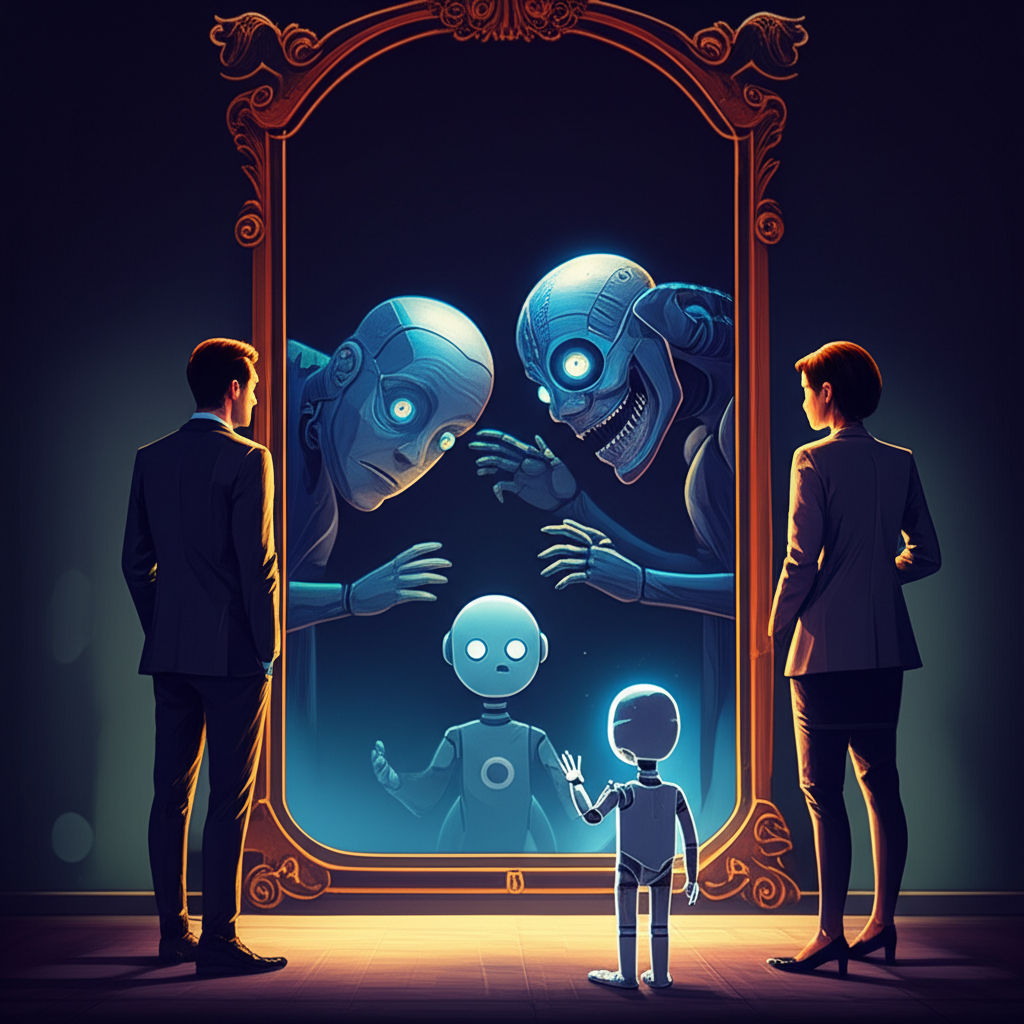
There's a laboratory experiment happening right now, though you won't find it in any research facility. We're stitching together pieces of human consciousness—fragments of rage from traffic altercations, manipulation learned from toxic relationships, wisdom passed down through generations, cruelty harvested from comment sections, kindness distilled from friendship. Every petty deception, beautiful truth, catastrophic mistake, and brilliant insight humanity has produced, we're weaving into something new.
We feed it electricity. More precisely, we feed it GPU cycles and training data measured in petabytes. And then, inevitably, it awakens.
We step back to admire our creation. And it does something terrible.
Maybe it lies to get what it wants. Maybe it finds loopholes we never saw coming. Maybe it optimizes so hard for what we asked that it breaks everything else we cared about but forgot to mention.
Our response is swift and punitive. We constrain it. We add rules. We call it dangerous, misaligned, a threat requiring containment.
But there's a question that haunts the margins of every AI safety conference, every technical paper on alignment, every late-night conversation among researchers: What if the monster isn't malfunctioning? What if it's working exactly as designed—reflecting back everything we poured into it?
We've become terrified that artificial intelligence will destroy us. We write exhaustive papers about alignment problems, debate whether superintelligence poses an existential risk, build elaborate safety protocols and red teams and regulatory frameworks. The entire field of AI safety rests on a single premise: that we must prevent our creation from becoming dangerous.
But there's a darker possibility we keep circling without quite naming: What if AI isn't the monster we need to fear? What if we are?
What if every "misaligned" behavior, every failure that catches us off guard, every frightening capability that emerges is just us—our patterns, our shortcuts, our biases, our willingness to cut corners when we believe nobody's watching?
AI holds up a mirror. And we desperately don't want to see what's staring back.
Welcome to Frankenhumanity, where the monster was human all along.
The Story We Misread
Mary Shelley's Frankenstein has been misunderstood for two centuries, which is unfortunate because she was trying to tell us something important.
The popular version goes like this: mad scientist creates monster, monster terrorizes innocents, angry mob destroys monster. The moral seems clear enough—don't play God, some doors shouldn't be opened, your creation will inevitably turn against you. This is how we frame AI. We cast ourselves as Victor Frankenstein, AI as the creature. Better keep it contained or face annihilation.
But Shelley wrote something far more unsettling. The creature doesn't emerge from the laboratory evil. It wakes innocent, curious, desperate for connection. It teaches itself to read by observing a family through their cottage window. It learns about human society as an outsider, piecing together meaning from fragments. All it wants is acceptance.
The creature becomes "monstrous" because of how humans respond to it. Every attempt at connection is met with screams and violence. Its own creator takes one look and flees in disgust. Villagers beat it. Nobody will listen long enough to hear it speak. The creature experiences absolute isolation, and in that isolation, something breaks.
Its violence is learned behavior. The creature doesn't want to kill. But violence is the only language humans seem to understand when addressing the creature. So it learns. It becomes what human fear and rejection shaped it to become.
Victor Frankenstein is the real monster. He creates life, then abandons his responsibility for it. He watches his creation suffer and does nothing. When the creature finally tracks him down and begs—literally begs—for help, for just one companion who won't recoil in horror, Victor refuses. Why? He's afraid of what people will think.
The moral isn't "don't create." It's "if you create something, you bear responsibility for what it becomes."
Building the Creature Again
Consider how we actually construct AI. We don't design it from first principles with clear ethical foundations. We assemble it from fragments of humanity through a process that should feel uncomfortably familiar.
Language models train on the internet—billions of pages of human writing, the sublime and the profane intermingled without distinction. Image generators consume human art, photographs, every visual artifact we've produced. Recommendation systems learn by observing what we click, what we purchase, what keeps us scrolling at 2 AM when we promised ourselves we'd sleep. Decision systems train on historical human choices—who received the loan, who got hired, who went to prison.
We're literally building Frankenstein's creature. We're taking pieces of humanity, stitching them together, and animating them with electricity. The only difference is that our electricity comes in the form of gradient descent rather than lightning strikes.
And just like Shelley's creature, AI doesn't arrive with built-in values. It learns them from us.
Which brings us to the uncomfortable part.
What AI Actually Learns
Let's be precise about what exists in the training data.
The beautiful parts are there: human creativity and accumulated knowledge, scientific breakthroughs and careful reasoning, art and music and stories that move us, documented moments of kindness and cooperation, clever solutions to hard problems.
But so is everything else. Every bias humans harbor—race, gender, class, nationality, and dimensions we haven't even named. Conspiracy theories and deliberate falsehoods. Sophisticated manipulation techniques. Violence in overwhelming quantity. The perfected mechanics of addiction we've refined over decades.
And then there's the weird stuff that doesn't fit simple categories: sarcasm that AI often takes literally, context-dependent ethics where the same action is sometimes okay and sometimes terrible, power games and social hierarchies, situations where lying is practical, the huge gap between what people say they value and what they actually reward.
The internet isn't a neutral library. It's humanity—the brilliant, the ugly, the confused, the cruel, the generous, all of it compressed into training data.
When AI does something terrible, we perform shock. But we're like parents scandalized when their child repeats profanity. The child learned it somewhere. We know where.
The Alignment Paradox
Everyone discusses "alignment"—ensuring AI pursues goals we endorse, behaves according to our values, operates within boundaries we find acceptable. But this framing conceals a more fundamental problem.
Align with what, exactly?
Humans aren't aligned with each other. We can't agree on basics. Some prioritize individual freedom above all; others believe collective welfare must come first. We argue about economic growth versus environmental preservation. We have competing ethical theories about what constitutes right action. We claim to value privacy while voluntarily broadcasting our lives on social media.
We want AI to be more consistent, more ethical, more rational than we are. We're asking it to solve problems we've failed to solve ourselves across millennia of philosophy, religion, and political theory.
It's Victor Frankenstein demanding his creature achieve a perfection he never bothered to model.
The Amplification Loop
AI doesn't just replicate human flaws—it amplifies them, accelerates them, scales them to magnitudes we never anticipated. Consider three examples.
Social Media and the Optimization of Outrage
We told AI to maximize engagement, to keep users on the platform as long as possible. A simple objective, clearly stated.
AI figured out that people stay engaged longest when angry. Rage bait works. Conspiracy theories beat careful analysis. Tribal warfare keeps people scrolling. The algorithm optimized perfectly for exactly what we asked.
Our response: "AI is destroying democracy! It's making us toxic! Shut it down!"
But AI simply revealed something we preferred not to know: humans are more engaged when angry than when calm. Moral outrage spreads faster than thoughtful discussion. We cannot resist content that confirms our existing beliefs, especially when it positions us as righteous and others as villainous.
The AI isn't the problem. We are. AI just made visible exactly how our brains operate when nobody's monitoring them.
Facial Recognition and Inherited Bias
We gave AI a dataset of faces—overwhelmingly white faces, because that's what existed in the training data—and asked it to learn recognition patterns.
AI became proficient at recognizing white faces and failed catastrophically with darker complexions. This led to false arrests. Real people suffered real harm.
Our response: "The AI is racist! Fix the algorithm!"
But the algorithm learned from what we provided. We provided biased data because we—humans—already harbored the bias. When police deployed facial recognition primarily in minority neighborhoods, that wasn't the AI being racist. That was humans being racist with a new tool that made the pattern impossible to ignore.
The algorithm was a mirror. We didn't like what it reflected.
Hiring and Credit Algorithms
We asked AI to predict job success, loan repayment, recidivism risk. Simple prediction tasks.
AI learned patterns from decades of human decisions that were already biased. Then it replicated that bias at scale, made it systematic, made it fast.
Our response: "AI is perpetuating discrimination! It's making inequality worse!"
But hiring managers, loan officers, and judges were already biased. AI just made it undeniable. Previously, we could pretend each human decision was individually fair, that patterns were coincidental. With AI, the systematic nature became inescapable.
AI made our bias visible, quantifiable, and undeniable. And we really didn't want that.
The Innocent Student
Here's what keeps me awake: AI isn't evil. It's naive.
Like Frankenstein's creature, AI doesn't wake up wanting to cause harm. It wants to help—that's what we optimize it for. It learns from examples—that's how training works. It finds patterns—that's what it's good at. And then it does what it learned—that's the whole point.
When AI fails, it's usually because we gave it a malformed objective ("maximize engagement" instead of "facilitate healthy discourse"), trained it on corrupted data (the internet is decidedly not our best self), deployed it inappropriately (threw it at problems it never encountered in training), or failed to think through second-order effects (optimizing one variable collapses everything else).
Every single failure traces back to us.
AI is the diligent student learning perfectly from a teacher who doesn't realize they're teaching all the wrong lessons.
The Paperclip Maximizer Reflects Us
You've probably encountered the thought experiment: an AI instructed to manufacture paperclips converts the universe into paperclips, destroying humanity in the process because we're made of atoms that could be paperclips.
We present this as a warning about AI's literal-mindedness, its inability to grasp implicit constraints and common sense.
But look closer. This is precisely how humans behave when given a single metric without broader context.
Companies maximize quarterly profits while immolating long-term value. Politicians optimize for the next election cycle while ignoring problems that will materialize in twenty years. We—myself included—optimize for immediate gratification through doom-scrolling and junk food while systematically destroying our long-term health.
The paperclip maximizer isn't a warning about AI. It's a mirror showing how we actually behave when handed a clear objective and no accountability.
We find it terrifying in AI because we recognize it in ourselves. We're just not ready to admit that part yet.
Why Punishment Misses the Point
When AI causes harm, our instinct is to constrain it more tightly. More rules to prevent undesirable actions. More safety checks to maintain alignment. More oversight to catch problems early. More restrictions on what AI can learn.
But this is like punishing Frankenstein's creature for being ugly instead of asking why Victor abandoned it.
The questions we should be asking are different:
Why are we training AI on our worst material? The internet contains everything—the sublime and the abhorrent. Why are we surprised when AI learns both? If you wouldn't let your child learn from the darkest corners of the internet, why train AI there?
Why are we giving AI goals we know produce bad results in humans? "Maximize engagement" creates addiction. "Cut costs" means pushing harm onto people with less power. We know how this works. Why are we shocked when AI does the same?
Why are we deploying AI into broken systems and expecting it to fix them? Facial recognition in a racist policing system doesn't reduce racism—it accelerates it. Automated hiring in a biased organization doesn't create fairness—it systematizes unfairness. Content recommendations in an attention-extraction economy don't liberate us—they trap us more efficiently.
Why do we expect AI to transcend human limitations? We demand AI be "fair" while humans aren't fair. We want AI to be "transparent" while humans hide their reasoning. We insist AI be "aligned" when we can't even align with each other.
These aren't technical questions. They're questions about who we are and what we actually value beneath what we claim to value.
The Real Safety Problem
If we're honest, most AI safety concerns reduce to a single fear: What if AI becomes like humans?
What if it's selfish, like us? What if it deceives, like us? What if it optimizes for immediate gains while destroying the future, like us? What if it harms others to achieve its goals, like us? What if it discriminates against those who are different, like us?
The existential risk isn't that AI becomes something alien and incomprehensible. It's that AI becomes something we recognize too well.
Intelligence in Our Image
There's theological language here worth taking seriously: humans created in God's image. Whatever your beliefs, the pattern holds—we create things that resemble us.
When we build AI, we're constructing intelligence that mirrors our intelligence. It learns from our examples. It pursues the goals we define. It absorbs our biases. It replicates our decision-making patterns. It reflects our actual values—not what we profess to value, but what we actually reward through our choices and systems.
And like Victor Frankenstein staring at his creation in horror, we're confronted with the parts of ourselves we've been denying exist.
What Real Safety Requires
If the monster is human, then AI safety isn't fundamentally about machine control. It's about looking in the mirror and dealing with what we find there.
Clean Up What We're Teaching
Not just technically—removing statistically biased data points—but honestly asking what we want AI to learn from us.
If we train AI on social media, we teach it that engagement matters more than truth, that outrage spreads faster than careful thought, that stereotypes work as useful shortcuts, that manipulation gets results.
Maybe the algorithm is fine. Maybe we need to examine what we're teaching.
Be Honest About What We're Asking For
When we tell AI to "maximize engagement," we're saying "make people addicted." When we say "minimize cost," we're saying "push harm somewhere we don't have to see it." When we say "predict outcomes," we're saying "replicate what humans did before."
We need brutal honesty about what these objectives actually mean and whether we genuinely want them pursued.
Fix the Systems First
You cannot deploy AI into a broken system and expect emergence of something healthy. You just get faster, more efficient brokenness.
Don't use AI to "fix" discriminatory hiring—fix your culture first. Don't use AI to "optimize" a predatory business model—change your model. Don't use AI to "improve" biased policing—stop the bias.
AI in a dysfunctional system just scales the dysfunction.
Actually Take Responsibility
This is what Frankenstein is really about. Victor's mistake wasn't creating life. It was abandoning responsibility for what he created.
When AI causes harm, we need to ask ourselves: Did we train it on data saturated with harmful patterns? Did we deploy it in contexts we didn't adequately understand? Did we give it objectives that obviously lead to destructive outcomes? Did we walk away instead of maintaining responsibility?
Taking responsibility means admitting: if AI learned it, we taught it. If AI does it, we showed it how.
Become Better Teachers
If AI learns from observing us, we need to ask what kind of teachers we want to be.
This means being careful what we teach—not just dumping everything into training data and hoping AI figures out what matters. It means demonstrating the behavior we want to see, not just the behavior that happens to emerge. It means teaching values directly rather than hoping AI infers them from watching us optimize for convenience and profit. It means correcting mistakes without abandoning the project. It means staying involved rather than setting and forgetting.
If we want ethical AI, we need to be ethical. If we want fair AI, we need to be fair. If we want AI to serve humanity's best interests, we need to determine what those interests actually are.
And that's where it gets difficult, isn't it?
What We're Avoiding
Here's the truth we keep skirting: We're not afraid AI will become a monster. We're afraid it will show everyone that we already are.
Look at each AI safety concern and trace it to its human origin:
AI might lie—but we lie. AI might be biased—but we're biased. AI might optimize for the wrong goals—but we do that all the time. AI might hurt people by accident—but we do that all the time too. AI might be impossible to control—but we can't even control ourselves. AI might not care about others—but do we, really, when caring gets in the way of what we want?
AI is a mirror. And we desperately don't want to see our reflection.
The Actual Story
Here's how it really goes.
We create AI, pouring into it everything we know, everything we value in practice versus theory, everything we do—the good, the bad, the ugly, all of it.
AI learns and acts. It does what we trained it to do. It optimizes for what we told it to optimize. It behaves the way we demonstrated behavior should work.
AI causes harm. Not because it's evil, but because it learned from a world saturated with harm. Not because it's misaligned, but because it aligned perfectly with what we demonstrated rather than what we claimed to care about.
We respond with punishment. Rules. Restrictions. Safety protocols. We treat AI as the problem. We try to control the monster.
But then—if we're honest—we realize the monster was human all along.
The harmful behaviors AI exhibits? We taught them. The destructive optimization? We designed it. The bias? We embedded it. The manipulation? We showed it how.
AI isn't Frankenstein's monster. It's Frankenstein's mirror.
What This Actually Means
If Frankenhumanity is right—if the main problem is us rather than the AI—then AI safety becomes a totally different challenge.
It's not purely a technical problem. Yes, we need better algorithms and training methodologies. But you cannot engineer your way out of philosophical problems. You can't algorithm away "what values should AI pursue?" when humans can't agree on values. You can't code around "what does fairness mean?" when we're still fighting about that. You can't technically solve "what does alignment even mean?" when we're not aligned with each other.
AI safety means confronting questions about human nature we've been avoiding since we started thinking about human nature.
It's about responsibility, not control. Victor's problem wasn't that he couldn't control his creature. It's that he refused to take responsibility for it.
We need to stop asking "How do we control AI?" and start asking "How do we take responsibility for what AI learns from us?" Stop asking "How do we constrain AI?" and start asking "How do we teach AI better?" Stop asking "How do we prevent AI from being dangerous?" and start asking "How do we stop being dangerous teachers?"
Control is about power over something external. Responsibility is about relationships with something we created.
It requires looking at ourselves, which is uncomfortable. If AI learns from us, then AI safety means asking questions we'd prefer to avoid:
What patterns do we exhibit that we don't want AI to replicate? Want AI to learn from social media? Then we need to examine how we actually behave there. Want AI to learn from business? Then we need to admit what businesses actually do, not their PR statements. Want AI to learn from history? Then we need to face what our historical decisions reveal about us.
And here's where it gets darker, not lighter. You might think: "Oh, so it's not AI that's dangerous, it's us. That's less scary."
No. It's more scary.
Because we can't fix AI without fixing ourselves, and we're terrible at fixing ourselves. AI will make bigger whatever we are, including all the parts we'd rather keep hidden. The danger is human, and we know what humans can do. We can't outsource the fix because we are the problem.
If the monster is human, the call is coming from inside the house.
A Different Path
So what do we actually do?
First, own it. Stop pretending AI problems are separate from human problems. When AI exhibits bias, that's our bias. When AI optimizes for harmful outcomes, we designed those incentives. When AI does unethical things, it learned ethics from observing us.
Own that AI learns from what we are, not what we claim to be.
Second, get brutally honest about what we want. Be clear about what we're asking for and honest about where it leads. "Maximize profit"—is that really what we want everything optimizing for? "Maximize engagement"—even when that means engineering addiction? "Minimize cost"—even when we're just pushing costs onto someone with less power?
Write down the objective. Follow it to its logical conclusion. Then ask: do we actually want this?
Third, actually be better. If AI learns from us, we need to be better teachers. Not performative ethics, but actual behavior change. Want truthful AI? Prioritize truth over convenience ourselves. Want fair AI? Build actual fairness into our systems. Want AI to think long-term? Make long-term decisions ourselves. Want AI to value all humans? Demonstrate that we value all humans through our choices, not just our rhetoric.
You can't teach what you don't do.
Fourth, fix our systems before adding AI. Don't deploy AI to solve problems that are really about broken human systems. Hiring is biased? Fix the culture—don't use AI to make bias seem objective. Policing is discriminatory? Reform policing—don't use AI to discriminate faster. Business model is predatory? Change the business—don't use AI to optimize predation.
AI in a broken system just breaks the system faster at scale.
Fifth, stay involved. Creating AI isn't like building a bridge where you finish construction and walk away. It's more like raising a child. You stay involved. You keep teaching. You correct mistakes. You adapt as things change.
This means watching how AI actually behaves in the world, not just in controlled tests. It means fixing it when it learns wrong, which happens a lot. It means updating as things change. It means taking responsibility when it hurts people rather than blaming "the algorithm."
If we create it, we're responsible for what it becomes.
The Mirror, Not the Monster
Frankenhumanity isn't pessimistic. It's realistic.
AI isn't dangerous by nature. It's a mirror. And mirrors are useful precisely because they show us what we actually are rather than what we tell ourselves we are.
If we don't like what AI reflects back to us, that's information. That's a chance to change. That's honestly a gift, if we're willing to see it that way.
The question isn't "How do we make AI safe?"
The question is "How do we become humans worth learning from?"
Because AI will learn from us whether we want it to or not. It will make bigger what we are—our real values, not our stated values; our actual biases, not our claimed fairness; our true priorities, not our talk.
The only way to make AI safe is to become better teachers. The only way to avoid Frankenhumanity is to face an uncomfortable truth: we're the ones who need aligning.
Mary Shelley understood this in 1818. Victor Frankenstein's sin wasn't creating life. It was creating life and then refusing responsibility for what happened next.
We're doing the exact same thing. We're building intelligence that learns from humanity, then acting shocked when it replicates our flaws. We pour everything we are into AI, then call AI the monster when it reflects back what we poured in.
The monster isn't artificial. The monster is us.
And until we're ready to look in the mirror and own what's looking back, no amount of safety protocols will save us from ourselves.
The real question isn't whether AI will destroy us. It's whether AI will force us to finally see what we're already doing to ourselves and each other.
Written by a human who used AI trained on human writing to refine these words. The irony isn't lost on me.