
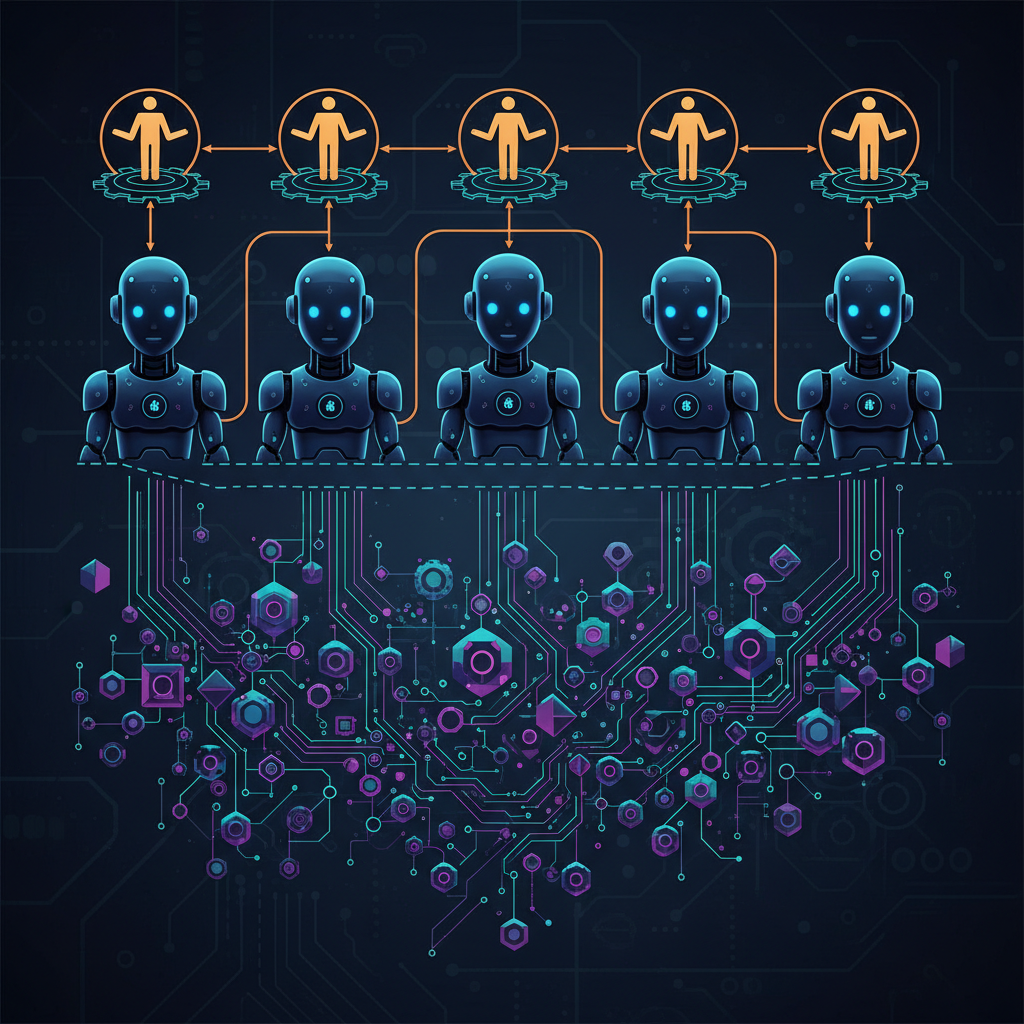
Front-End vs Back-End Agents: Why Separation is Critical for Autonomous Systems
When I first started building multi-agent systems, I made the mistake of treating all agents the same. They all had similar permission levels, similar approval workflows, and similar autonomy. It didn't take long to realize this was fundamentally wrong.
The breakthrough came when I recognized something obvious in hindsight: agents that face the public have completely different risk profiles than agents that operate internally. This insight reshaped our entire agent architecture.
The Core Problem: Not All Actions Are Equal
Consider two agent actions:
- An agent optimizes database query performance by restructuring indexes
- An agent tweets on behalf of your company account
Both are "agent actions." But the consequences of getting them wrong are radically different.
A bad database optimization wastes compute time and you roll it back. A bad tweet? That lives forever in screenshots, damages your reputation, and potentially moves markets if you're a public company.
This asymmetry demands different architectures.
The Two-Tier Model
We've settled on a clear separation between what I call front-end agents and back-end agents. The terminology borrows from traditional software architecture, but the meaning is distinct.
Front-End Agents (Human-in-the-Loop Required)
These agents interact with the public or produce externally-visible outputs. In our system:
- ian-pr: Handles public relations, press responses, and official statements
- comms-manager: Manages communications across platforms, coordinates messaging
- content-lead: Creates and curates content for blogs, social media, and newsletters
What defines a front-end agent:
- External-facing output: Their work is seen by people outside the organization
- Reputation risk: Mistakes can cause lasting damage
- Approval workflows: Every public action requires human review
- Lower autonomy ceiling: Even when confident, they wait for sign-off
The key insight is that these agents don't need to be slower—they need to be safer. They can do all the preparatory work (research, drafting, optimization) autonomously, but the moment of publishing requires a human decision.
Back-End Agents (Autonomous Operation)
These agents handle internal operations where the blast radius of mistakes is contained:
- optimizer: Performance tuning, resource allocation, cost optimization
- supernal-lead: Manages agent infrastructure, coordinates agent deployments
- docs-agent: Maintains internal documentation, updates technical specs
What defines a back-end agent:
- Internal scope: Their work affects operations, not external perception
- Recoverable failures: Mistakes can be detected and reversed
- High autonomy: Can act without human approval for most operations
- Speed matters: These systems need to respond quickly to changing conditions
The docs-agent is a good example. It continuously updates our internal documentation as code changes. If it makes an error, we catch it in review or someone notices and flags it. The cost of a documentation mistake is a confused engineer; the cost of not having automated docs is outdated information everywhere.
Why This Separation Matters
1. Different Approval Flows
Front-end agents use what I call "staging workflows." They prepare content, then present it for review:
Research → Draft → Optimize → HUMAN REVIEW → Publish
Back-end agents use "exception-based" workflows. They act autonomously but flag anomalies:
Monitor → Decide → Act → Log → (Alert if unusual)
Trying to force both agent types into the same workflow either makes your public-facing work dangerously fast or your internal operations frustratingly slow.
2. Different Risk Tolerances
I want my optimization agent to experiment. Try different approaches, measure results, iterate quickly. A 5% performance regression that's caught in an hour is fine—that's how we find improvements.
I want my PR agent to be conservative. When in doubt, don't publish. Ask for clarification. The cost of waiting is almost always lower than the cost of a public mistake.
These are opposite risk profiles that require different system designs.
3. Different Feedback Loops
Front-end agents learn from human feedback: "This draft was good, but tone it down for LinkedIn" or "Add more technical detail for the engineering blog."
Back-end agents learn from metrics: response times, error rates, cost per operation. They can self-evaluate against quantitative goals without human interpretation.
How They Coordinate Without Conflict
The obvious question: how do you prevent agents from stepping on each other?
We use three mechanisms:
Domain Boundaries
Each agent has a clear scope. The content-lead doesn't touch infrastructure configs. The optimizer doesn't draft blog posts. This seems obvious but requires explicit definition—agents will expand their scope if you let them.
Event-Based Communication
Agents communicate through structured events rather than direct interaction:
- Optimizer completes a significant improvement → Publishes event
- Content-lead sees event → Drafts internal update (if noteworthy)
- Human reviews → Approves external announcement (if appropriate)
The front-end agent doesn't need to know how the optimization happened. It just needs to know what was accomplished and why it matters.
Priority Hierarchies
When conflicts arise (rare but possible), we have clear precedence:
- Human override always wins
- Front-end concerns override back-end efficiency
- Safety concerns override speed concerns
If the optimizer wants to take a service down for maintenance and the comms-manager says "we have a product launch in 2 hours," the maintenance waits.
Real Examples from Our Architecture
Example 1: Blog Post Publication
- content-lead (front-end) researches topic, drafts post, optimizes for SEO
- docs-agent (back-end) automatically updates related internal docs
- content-lead submits draft for human review
- Human approves/requests changes
- content-lead publishes
- comms-manager (front-end) prepares social promotion, waits for approval
- Human approves social posts
- optimizer (back-end) monitors engagement, suggests timing for future posts
The front-end agents stop at approval gates. The back-end agents run continuously.
Example 2: Infrastructure Update
- optimizer (back-end) identifies opportunity to reduce costs by 15%
- optimizer implements change in staging, validates
- optimizer rolls out to production during low-traffic window
- supernal-lead (back-end) updates agent configurations for new infrastructure
- docs-agent (back-end) updates runbooks and documentation
- comms-manager (front-end) optionally prepares internal announcement → human decides if worth sharing
Notice how the internal work completed without approval checkpoints, but the moment we consider external communication, a human enters the loop.
Example 3: Crisis Response
- Monitoring detects issue
- optimizer (back-end) automatically scales resources
- supernal-lead (back-end) notifies relevant agents
- comms-manager (front-end) drafts status update → IMMEDIATE human review
- Human approves (or takes over communication directly)
- ian-pr (front-end) prepares follow-up messaging → awaits approval
In a crisis, back-end agents buy us time with automated response. Front-end agents prepare communication options. But humans drive all external messaging during high-stakes moments.
Implementation Principles
If you're building a similar system, here's what I've learned:
1. Default to front-end classification when uncertain. It's easy to grant more autonomy later. It's hard to recover from a public mistake.
2. Make approval gates low-friction. If reviewing and approving takes 10 seconds, people do it consistently. If it takes 5 minutes, they start rubber-stamping.
3. Give back-end agents excellent logging. Autonomy requires observability. You should be able to reconstruct exactly what happened and why.
4. Define "public" broadly. Email to a customer is public. Slack to a partner is public. Internal-all announcement at a big company is effectively public. When in doubt, require approval.
5. Review classifications quarterly. As you build trust in agents and systems, some front-end agents might earn more autonomy. Some back-end agents might expand scope in ways that require new checkpoints.
The Bigger Picture
This separation isn't just about risk management—it's about building AI systems that humans can trust and work with.
When front-end agents reliably wait for approval, humans trust them. When back-end agents reliably handle routine tasks, humans appreciate them. The combination creates a system where AI handles the mechanical work while humans retain control over what matters most: how we present ourselves to the world.
The agents that will succeed long-term aren't the most autonomous ones. They're the ones that are autonomous in the right ways—efficient where speed matters, careful where stakes are high.
We're still early in figuring out multi-agent architectures. But this front-end/back-end separation has become one of our most important design patterns. It lets us build capable, fast-moving agent systems while maintaining the human oversight that makes them safe to deploy.
The line between front and back isn't always obvious, and it will shift as AI capabilities improve. But the principle holds: different risk profiles demand different architectures. Build accordingly.