
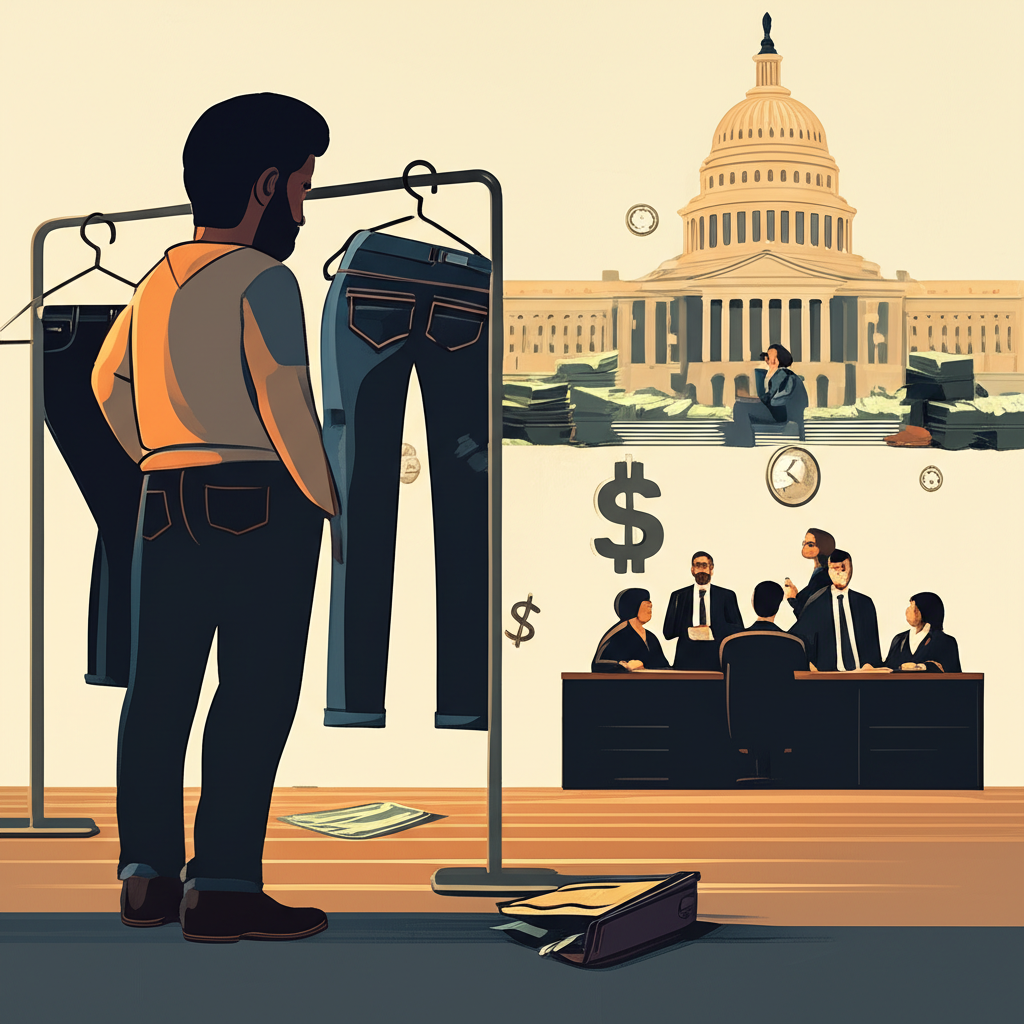
You know your house wastes energy. Adding insulation would cut your heating bill by 30%. But it costs 15,000. So you keep burning oil you can't afford, polluting air you have to breathe.
The oil company CEO knows his product destroys the climate. But if he stops lobbying Congress, his competitors won't. They'll get favorable regulations. His company will lose billions. Shareholders will replace him. So he keeps writing checks to politicians, hating every minute of it.
The single mom knows Walmart pays poverty wages. She knows her tax dollars subsidize their workers' food stamps because the company won't pay living wages. She knows they destroy local businesses.
But her kids need school supplies. Local stores charge 15. She makes $32,000 a year. Where's she supposed to shop?
So she goes to Walmart, buys the cheap stuff, and feels like garbage about it. Her taxes subsidize Walmart's employees. Her purchases subsidize Walmart's profits. She's trapped funding the exact system that keeps her poor.
Welcome to the trap. Being moral costs money. Sometimes money you have but can't afford to wait to get back. Sometimes money you'll never have at all.
The Real Problem: ROI You Can't Afford to Wait For
Here's what makes the trap so brutal: moral choices often have positive returns on investment. They pay back. Eventually.
But "eventually" might be 10 years. Or 20. And you need to eat next month.
That homeowner with the leaky house? The insulation upgrade saves 15,000 today, and she's living paycheck to paycheck.
The small business owner knows he should switch to renewable energy. The solar panels would cut his electricity bill by 60,000. That's 6+ years to break even. Six years is forever when you're trying to make payroll.
This is the trap. The moral choice has better long-term economics. But the short-term cost is impossible.
You want to stop using fossil fuels? Good luck. Most places have no public transit. You need a car to work. Your food came on diesel trucks. Your electricity comes from coal plants. Even "green" energy needs batteries made from strip-mined lithium.
You want to boycott companies doing terrible things? Your data is locked in their cloud. Your network is on their platform. Your clients use their tools. Leaving means starting over.
The system makes moral choices expensive upfront, with returns that come too slowly for most people to afford the wait.
Everyone Faces This Trap - Just at Different Scales
The cost of being moral doesn't care about your bank account. It scales with you.
The Homeowner: $28K They Don't Have
Sarah's heating bills are killing her budget. 28,000 upfront but save $2,000 per year.
14 years to break even. She doesn't have 14 years of savings. She has $800 in her checking account.
So she keeps buying oil she can barely afford, burning fossil fuels she knows are cooking the planet. Not because she doesn't care. Because the upfront cost is impossible.
The Low-Wage Worker: Trapped in the Cheap Store Loop
Maria makes $32,000 a year. She knows Walmart and Amazon exploit workers and destroy local businesses. She knows her tax dollars subsidize their employees' food stamps because they won't pay living wages.
But where else can she shop? The local hardware store charges 6 at Walmart. The farmer's market tomatoes are 2 at the grocery chain. Her kids need school supplies - the local bookstore wants 15 at Target.
She's not rich enough to be moral. Every time she shops at the places she hates, she's funding the system that keeps her wages low. It's a closed loop designed to trap her.
The Small Business: $500K in Lost Contracts
Tech startup founder knows his cloud provider has terrible labor practices and burns fossil fuels for data centers. There are smaller, more ethical alternatives.
But his biggest client requires The Cloud provider for "security compliance." His second-biggest client has their entire workflow built on integrations. Switching would cost him both contracts - 60% of revenue. He'd have to lay off half his team.
So he stays on The Cloud provider, writes the checks, and feels sick about it.
The Fortune 500 CEO: $50 Billion in Market Cap
The pharmaceutical CEO knows drug prices are insane. A cancer drug that costs 12,000 per dose. It's morally indefensible.
But here's his choice:
- Lower prices to ethical levels → Revenue drops 40% → Stock crashes → Board fires him → Replacement raises prices back up → Nothing changes except he's unemployed
Or worse:
- He lowers prices → Competitors don't → They use extra profits to buy his company → Raise prices higher than before → Patients are worse off
So he keeps the prices high and donates to charity to sleep at night. The system doesn't give him better options.
The Billionaire Lobbyist: $10M to Congress or Lose Everything
The clean energy company CEO built his business on solar panels. He wants to save the planet. That's literally his business model.
But oil companies spend $200 million per year lobbying Congress. They're writing regulations to kill solar subsidies and protect fossil fuel tax breaks. If he doesn't lobby back, his industry dies.
So he hires lobbyists. He bundles campaign donations. He plays the same dirty game as Big Oil, just with less money. He hates it. But if he stops, Congress will kill his company, and oil wins completely.
The trap exists at every level. The numbers change. The principle doesn't. Being moral costs more than most people or companies can afford in the short term - even when it would pay off long-term.
The Flip Side: Long-Term Costs of Being Immoral
Here's the twisted part: being immoral often costs way more in the long run. But those costs come later, so the system ignores them.
The Homeowner: About $75K in Damage
Sarah keeps burning oil because she can't afford $28K for insulation. Over 30 years:
- She gives up 2,000 a year for 30 years) that the upgrade would have paid back after 14 years
- Her inefficient house drops in value as energy prices rise
- When her ancient furnace finally dies, emergency replacement costs $15K (costs come down).
- The house she could have made more valuable is now worth less
Total extra cost: about 60,000 in forgone savings plus a $15,000 emergency furnace replacement). Plus decades of guilt about the environment.
The Fortune 500 CEO: Regulation That Destroys the Industry
The pharma CEO keeps drug prices sky-high. Congress gets so angry they pass price controls - but crude ones that kill R&D funding. The whole industry suffers.
Or worse: Public anger gets so extreme that single-payer healthcare passes. The entire private pharma industry collapses. Every company loses.
If the industry had voluntarily lowered prices to reasonable levels, they could have avoided the backlash. Short-term greed triggered long-term destruction.
The Billionaire Lobbyist: System Collapse
Oil companies spent billions lobbying against climate action. They won every fight for 40 years.
Now:
- Climate disasters cost the global economy hundreds of billions, and soon trillions
- Insurance markets are collapsing
- Coastal properties (including their own) are underwater
- Social instability threatens the whole economic system
They saved maybe 10+ trillion loss due to climate damage.
Even for them, being immoral was more expensive. They just couldn't afford the upfront cost of doing the right thing.
The Timing Problem
The trap works because moral choices cost money NOW, with returns coming LATER - often much later. Immoral choices profit NOW, with costs coming LATER when it's someone else's problem.
Companies optimize for quarterly earnings, not decade-long stability. Homeowners need to pay this month's heating bill, not save money 15 years from now. Politicians need to win the next election, not solve long-term problems. Workers need to buy groceries this week, not support local businesses that charge double.
The system is built for short-term thinking. Being moral requires long-term thinking. Most people and companies can't afford to think long-term when they're barely surviving short-term.
Why Your Individual Sacrifice Achieves Nothing
The cost of being moral gets even worse when you realize: your personal sacrifice probably won't change anything.
You could stop driving and bike everywhere, adding 3 hours to your day. You could buy only ethical products, doubling your expenses. You could quit social media, losing work opportunities. You could move somewhere with public transit, leaving family and job.
But if you're alone in this, the systems don't change. You just become poorer, more isolated, and less able to create actual change.
The math is brutal: Individual moral action has almost zero impact on systems. But it has very real personal costs.
Meanwhile, people who don't make these sacrifices keep their money and time, stay connected to opportunities, build careers and networks, and face zero consequences. They get better outcomes without the moral cost.
The system rewards moral indifference and punishes moral action.
What It Does to Your Head
The practical costs are bad enough. The psychological damage is worse.
Living in constant contradiction between your values and your actions hurts. You know you're participating in harm. The weight of compromises builds up. You slowly accept that you can't live ethically. Eventually you stop caring because caring hurts too much.
And then there's the judgment. People who can afford to be ethical love judging people who can't. The person with solar panels judges people on grid power. The person in a walkable city judges people who drive. The person with independent income judges people locked into corporate systems.
But they're not better people. They're just rich enough to afford the cost of being moral.
Common Responses That Don't Work
People have standard responses to this trap. None of them fix it.
"Vote with your wallet," they say. This assumes you have a wallet. And that companies care about ethics more than profits. Reality: Consumer boycotts rarely work. They're performance art.
"There is no ethical consumption under capitalism," others point out. True. But people use this as an excuse for choosing the most convenient option instead of the least harmful one. If everything is equally bad, why bother trying?
"Focus on systemic change, not individual action," the activists say. Partially right. But systemic change needs collective individual action. You still have to live your life while working for change. And some individual choices do reduce harm.
"Be the change you want to see," says the inspirational poster. Nice sentiment. Ignores reality. Individual sacrifice without collective action achieves nothing. Not everyone can afford to "be the change." And moralizing individual behavior hides systemic problems.
So What Do You Actually Do?
You can't opt out. You can't afford perfect morality. Individual action seems pointless.
Here's what actually helps:
First, stop beating yourself up. You're in a trap. Not because you're a bad person. Because the system makes ethical living expensive or impossible. Stop feeling guilty for driving that car or shopping at Walmart or using that platform when you have no real alternative.
Second, make easy choices when you can. When switching costs are low, switch to less harmful options. When you have real choices, pick the less harmful one. When your money gives you options others don't have, use them. But don't destroy your ability to function for symbolic gestures that change nothing.
Third, calculate what's worth the cost. Becoming a hermit to reduce your carbon footprint? High cost, zero impact. Skip it. Organizing collective action? High cost, but high impact. Consider it. Switching to ethical alternatives when they cost the same? Low cost, any impact. Usually worth it. Supporting mutual aid networks and organizing communities? Low cost, builds capacity. Always worth it.
Fourth, work to reduce switching costs for everyone. Stop moralizing individual choices. Start reducing the costs that make ethical living expensive.
Support policies that make ethical alternatives cheaper - renewable subsidies, public transit, higher minimum wages so people can afford to shop somewhere other than Walmart. Fight policies that lock people into harmful systems. Push for making harmful options more expensive through things like carbon taxes.
Help build alternatives. Tool libraries, food co-ops, mutual aid networks. Support businesses that reduce lock-in through open source software and data portability. Create resources that lower the cost of ethical living for your community.
Find others facing the same traps. Coordinate switching together to beat network effects. Build collective power to demand better options. One person leaving Amazon does nothing. Ten thousand leaving together gets attention.
The Real Question
How do I reduce harm while keeping the ability to create real change?
Sometimes that means using Amazon because it's how you afford essentials, so you have resources for other fights. Sometimes it means driving a car because public transit doesn't exist, so you can keep your job. Sometimes it means staying on bad platforms because that's where organizing happens. Sometimes it means shopping at Walmart because you literally cannot afford the alternative.
Participating in harmful systems while you work to change them isn't moral failure. It's acknowledging reality and surviving long enough to fight for something better.
The Uncomfortable Truth: We're All Trapped Together
There is no individual solution to the cost of being moral.
You can't personally escape these traps through better choices. The traps are built into the system. They need collective action to break.
But collective action needs individuals who know they're in a trap, who don't moralize individual survival, who focus energy on changing systems instead of perfecting personal purity, and who build alternatives that reduce costs for everyone.
The cost of being moral shouldn't be impossibly high. The fact that it is means the system is broken, not that you, or anyone else, is failing.
Point your anger at systems that make moral living expensive. Not at individuals trying to survive within those systems.
We're all paying the cost of being moral. We should work together to make that cost lower for everyone.
What Actually Needs to Happen
We need to ask different questions:
What collective actions reduce the cost of ethical living for everyone? What systemic changes make harmful options more expensive and ethical options cheaper? How do we build alternatives that don't need impossible sacrifices? How do we stop moralizing individual survival while still pushing for systemic change?
The goal is systemic change that makes ethical living possible.
When minimum wage is 28,000 upfront, you can't blame homeowners for burning oil. When every competitor lobbies Congress, you can't blame CEOs for doing the same.
The answer is raising minimum wage so people can afford ethical alternatives. Subsidizing solar so the upfront cost isn't impossible. Getting money out of politics so CEOs don't have to bribe Congress to compete.
You're trapped in systems that make moral living expensive or impossible. That's not your fault. It's systemic design that needs to change.
Stop beating yourself up for driving that car, shopping at Walmart, using that platform, or buying that cheap product. You're doing your best within impossible constraints.
Point your energy at changing the systems that create these impossible choices.
The cost of being moral shouldn't bankrupt us. Let's build a world where it doesn't.
Revision note (2026-10-26): Corrected the homeowner arithmetic. 3,500 x 30), not the extra cost. Against the upgrade she saves 60,000. Headlines updated to match the text. Revert if you prefer the earlier figures, but they did not add up.