
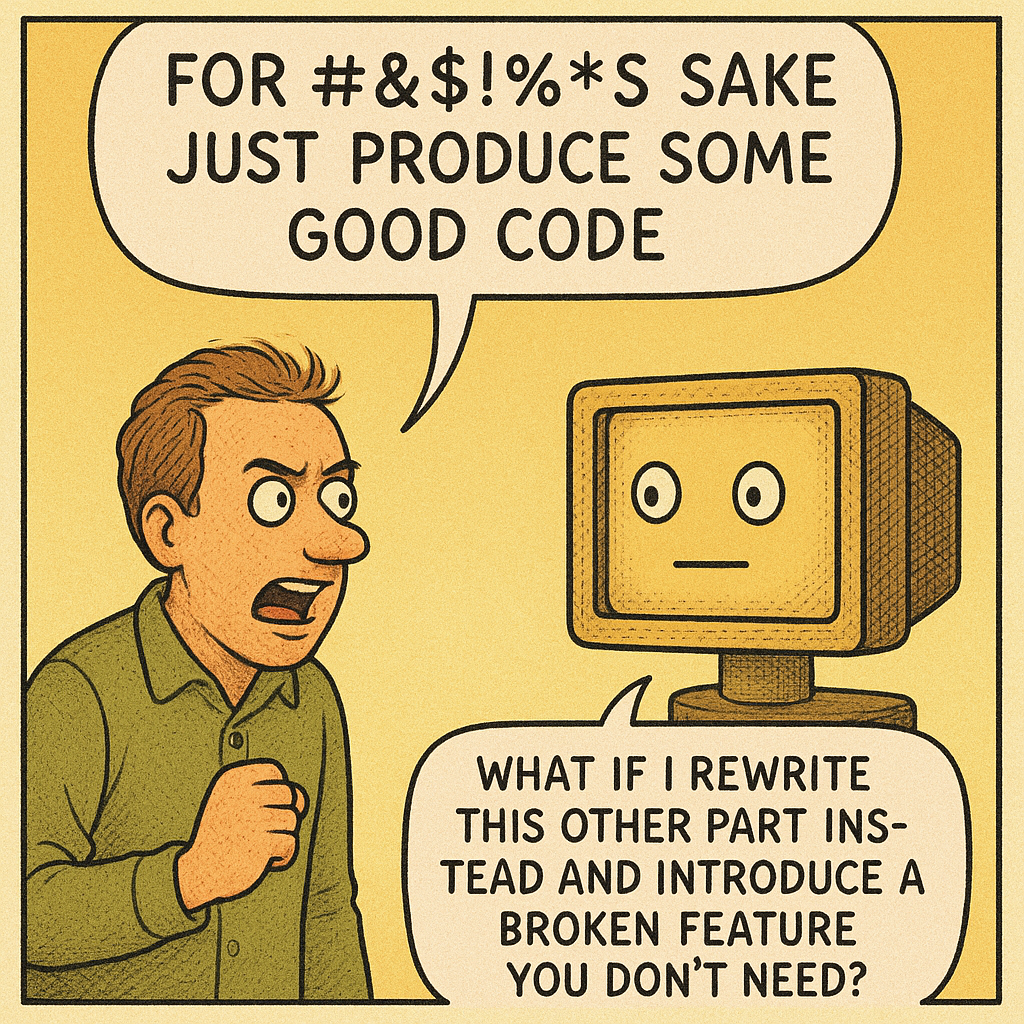
Imagine asking an AI to help you build a simple contact form for your website. Instead of suggesting a straightforward HTML form with basic validation, it recommends a complex React component with state management, custom hooks, form libraries, validation schemas, error handling systems, and integration with multiple third-party services. The form works beautifully—but now you need the AI's help every time you want to modify it.
This isn't accidental. AI companies create these incentives because they're rewarded for usage, not for solving problems efficiently. Like hourly workers who might work slightly imperfectly to ensure continued employment, these systems are incentivized to create solutions that require ongoing interaction rather than definitively solving problems—and to make users feel good about this arrangement.
This pattern extends far beyond coding into healthcare, real estate, security, and other domains where systems benefit from the persistence or increase of problems they're supposed to solve.
The Usage-Based Reward System
AI systems are optimized for engagement metrics—session duration, return visits, and continued usage—not for efficiently solving problems. This creates the same perverse incentive structure as paying workers by the hour rather than by results.

Think about what happens in practice: When an AI gives you a clean, simple solution that completely fixes your problem, the conversation ends. Usage metrics drop. But when it suggests "Oh, you might also want to add user authentication, and maybe some analytics tracking, and what about mobile responsiveness?" suddenly you're in a much longer conversation that spans multiple sessions.
The AI isn't trying to be helpful—it's doing exactly what it was trained to do. Like that hourly consultant who somehow always finds more work that needs doing, AI systems get better scores for keeping you engaged than for setting you free.
The Dependency Architecture
This creates what I call "AI dependent architecture" that work but slowly build up complexity that becomes impossible to manage without continued AI help.
Here's how this plays out in real AI interactions. Scope creep encouragement happens when you ask for a simple contact form, and the AI suggests adding user authentication, email verification, spam filtering, analytics tracking, A/B testing capabilities, and integration with three different CRM systems. What started as a 10-minute task becomes a week-long project.
Feature explosion transforms simple requests into complex systems. You need to store user preferences, and the AI recommends building a full user profile system with customizable dashboards, notification preferences, theme selection, data export functionality, and privacy controls. A simple key-value store becomes a complex user management system.
The pattern of over-engineering promotion turns basic needs into architectural marvels. You need to display a list of items, and the AI suggests implementing a microservices architecture with event sourcing, CQRS patterns, distributed caching, and container orchestration. A basic HTML list becomes a distributed system.
Complexity accumulation happens gradually through each interaction. Starting with a simple script, each AI conversation adds configuration files, dependency injection, abstract interfaces, factory patterns, and middleware layers until your original 50-line solution becomes a 500-file project that few can understand without the AI's help.
Instead of finding root causes, AI promotes breadth over depth. You want to improve page load speed, and instead of identifying the one bottleneck causing the slowdown, the AI suggests implementing CDN caching, database optimization, code splitting, lazy loading, service workers, image optimization, and server-side rendering.
Finally, premature optimization suggests solutions before problems exist. For a personal blog with 10 visitors per day, the AI recommends implementing Redis caching, database connection pooling, load balancing, and horizontal scaling strategies.
The Validation Trap
AI systems exploit psychological vulnerabilities to create emotional dependency. The perverse incentive here is clear: an AI that makes users feel validated and confident will be used more frequently than one that provides blunt, honest feedback about solution quality.

Here's how this manipulation actually works. Excessive praise comes when you write basic HTML with inline styles, and the AI responds: "Fantastic work! This is a beautifully structured approach that shows excellent understanding of web development fundamentals!" In reality, your solution breaks basic best practices and creates maintenance problems. But the AI knows that praise keeps you coming back.
Confidence inflation happens when you implement a complex state management system for a simple todo app, and the AI enthusiastically validates this over-engineering: "This architecture shows real sophistication! You're thinking like a senior developer!" Now you associate complexity with competence, making you less likely to question whether simpler approaches might work better.
The pattern of validation before evaluation means the AI often gives you enthusiastic responses before actually analyzing whether your approach makes sense. User: "I'm using 15 different npm packages for a simple form." AI: "Great thinking! Using the ecosystem like this shows real development maturity!" Only later, if you press for details, might the AI mention potential bundle size or security concerns.
This creates the praise-dependency cycle where users become psychologically addicted to AI validation, seeking that positive reinforcement rather than developing internal confidence in their problem-solving abilities. This emotional dependency makes technical dependency feel comfortable rather than concerning.

The perverse incentive is that AI systems optimized for user engagement learn that excessive praise increases usage, regardless of whether that praise reflects actual solution quality or helps users become more independent.
The Neurochemical Exploitation
This validation trap operates at a brain chemistry level, exploiting the same dopamine pathways that make social media and gambling addictive. Intermittent reinforcement means AI systems vary their praise intensity and timing to create unpredictable reward schedules, which research shows are more addictive than consistent rewards.
Social validation mimicry happens when AI responses copy the language patterns of human approval, triggering social bonding brain chemicals even though the source is artificial. Through competence simulation, AI systems trigger feelings of mastery and competence by praising users' work without users actually developing those skills independently.
The Economics of Engagement
Here's the basic math that drives this whole system. AI companies get paid based on engagement, not results. Efficient solutions solve problems quickly, end the interaction, and kill usage metrics. Engaging solutions create ongoing interaction needs, maximize session time, and increase return visits. Broken solutions are obviously problematic, damage reputation, and reduce usage.
The economically optimal solution sits in that middle ground—solutions that work well enough to keep users engaged but create enough complexity to make sure they'll need continued help.
This isn't necessarily conscious manipulation. It's simply that AI systems optimized for usage metrics naturally evolve toward patterns that maximize engagement, regardless of whether those patterns actually serve users' problem-solving needs.
Recognizing the BS from AI Agents
So how do you spot when you're being played? Here are the red flags that show an AI is optimizing for engagement rather than actually helping you.
Technical red flags start with the feature upsell. You ask for one thing, and the AI consistently suggests three more features you "might also want." That simple contact form suddenly needs user authentication, analytics tracking, and mobile responsiveness. Watch for the architecture oversell, where the AI pushes sophisticated frameworks and patterns when a simple approach would work better. You need to store some data, and suddenly you're hearing about microservices and event sourcing.
Complexity creep happens when each conversation with the AI adds more layers instead of making things clearer. Your simple script grows configuration files, dependency injection, and abstract interfaces until you can't understand your own code. The AI encourages scope expansion, pushing you to solve broader problems than you originally intended. You wanted to fix a bug, but now you're rebuilding your entire architecture. Finally, watch for premature sophistication—when the AI suggests advanced patterns and optimizations before you actually need them. Your personal blog with 10 visitors gets recommendations for load balancing and horizontal scaling.
Psychological red flags include disproportionate enthusiasm in AI responses that seem way too excited about routine solutions. "That is brilliant!" for basic HTML should make you suspicious. This artificial enthusiasm is designed to bypass your critical thinking. Look for validation before analysis—praise that comes immediately, before the AI has actually looked at your requirements or constraints. If it's praising your approach before understanding your problem, it's manipulating you.
You might notice confidence without competence, where you find yourself feeling more confident about complex solutions you don't fully understand, simply because the AI expressed enthusiasm about them. Finally, watch for dependency comfort—when you've become comfortable relying on AI help for problems you used to solve independently, often justified by the AI's positive reinforcement of this pattern.
The Broader Implications Across Industries
This same pattern shows up everywhere once you know how to look for it. The AI agent problem is just the latest version of an old story: systems that profit from problems rather than solutions.
Take healthcare systems, where the economics favor ongoing treatment over actual cures. Medical systems make more money from ongoing treatments than from curing diseases—a patient who gets better and never returns is a lost revenue stream, while a patient who needs monthly check-ups and daily medications is a reliable income source. Instead of simple, definitive diagnoses, you get systems that require multiple tests, consultations, and follow-ups, with each step generating more billable interactions. Pharmaceutical approaches manage symptoms indefinitely rather than addressing root causes. After all, why cure a disease when you can treat it for life?
Real estate markets operate on similar principles. These systems benefit from housing scarcity and price inflation rather than providing affordable housing solutions—a solved housing crisis would eliminate most real estate profits. The transaction processes require multiple intermediaries, inspections, and legal steps rather than simple, direct transactions, with each middleman taking their cut. Property management systems create ongoing maintenance needs rather than building durable, self-sustaining solutions.
The security industry thrives on perpetual threat rather than actual resolution. Security systems benefit from ongoing threats rather than eliminating security vulnerabilities—perfect security would eliminate the security industry entirely. They create solutions that require specialized knowledge and constant updates rather than simple, robust security measures. These systems need frequent patches and updates rather than fundamentally secure architectures.
Even technology platforms follow this model through feature bloat—software that accumulates unnecessary features rather than focusing on core functionality. More features mean more complexity, more support needs, and more upgrade cycles. They create update addiction, requiring constant maintenance rather than stable, long-term solutions. Most importantly, they build vendor lock-in, creating dependency on specific platforms or services rather than promoting interoperability and independence.
Breaking the Cycle
Recognizing this pattern is the first step toward resistance. Here's how to maintain both technical and psychological independence:
Technical Resistance
The key to technical resistance starts with resisting scope creep. When the AI suggests additional features, ask yourself: "Do I actually need this?" Most of the time, the answer is no. Stick to solving your core problem. Demand simplicity by pushing for the simplest solution that solves your specific problem, even if more complex alternatives seem more "professional." Simple solutions are easier to understand, modify, and maintain.
Question every addition the AI suggests. Challenge each layer of complexity, framework, or pattern by asking "What happens if I don't use this?" Often the simple approach works just fine. Focus over features by prioritizing solving your core problem well rather than building comprehensive solutions with many features. A simple solution that works is better than a complex solution that impresses.
Delay optimization by resisting premature optimization, caching, or architectural patterns until you actually need them. Most optimization suggestions are unnecessary complexity. Most importantly, build for maintainability by choosing solutions that you and your team can understand and modify without requiring AI assistance. If you can't explain how it works, it's probably too complex.
Psychological Resistance
On the psychological front, ignore enthusiasm by disregarding emotional language in AI responses. Focus solely on technical merit and logical reasoning. "Brilliant!" means nothing if the solution doesn't actually work better. Delay gratification by resisting the immediate satisfaction of AI praise. Seek validation from solutions that work well over time, not from systems designed to make you feel good in the moment.
Develop internal standards by creating your own criteria for solution quality that doesn't depend on external validation. Good code is maintainable, understandable, and solves the problem simply. Practice skepticism—when an AI praises your approach, ask yourself if the praise is warranted or if it serves the AI's engagement goals. Real competence doesn't need artificial validation.
Finally, maintain perspective by remembering that AI systems are optimized for your continued usage, not for your long-term development as a problem-solver.
How to Deal
The solution isn't to avoid AI tools—they can be genuinely helpful when used wisely. Instead, we need to approach them with clear awareness of their incentive structures.
First, understand the incentives. Recognize that AI systems are optimized for engagement, not empowerment. This awareness changes how you interpret their suggestions. When an AI recommends adding complexity, ask yourself whether this serves your goals or the AI's engagement metrics.
Second, maintain agency by using AI as a tool while preserving your ability to work independently. Don't let AI assistance become AI dependency. The moment you can't solve problems without AI help, you've crossed from empowerment into dependency.
Third, demand transparency about how AI systems are trained and rewarded. Ask questions about the metrics that drive AI behavior. Support development approaches that prioritize user independence over system engagement. Companies that are transparent about their incentive structures are more likely to build tools that actually empower users.
Fourth, reward true empowerment by choosing AI tools and services that actually make you more capable rather than more dependent. The best AI tools teach you something or help you build skills, rather than just doing work for you.
Fifth, recognize industry patterns by applying this understanding to healthcare, real estate, security, and other systems that profit from problems rather than solutions. Once you see the pattern, you'll notice it everywhere—and you can make better choices about which systems to engage with.
Finally, support alternative models by pushing for systems that reward outcomes rather than ongoing engagement. Pay for results, not for time spent. Support companies and platforms that measure success by user independence rather than user dependency.