
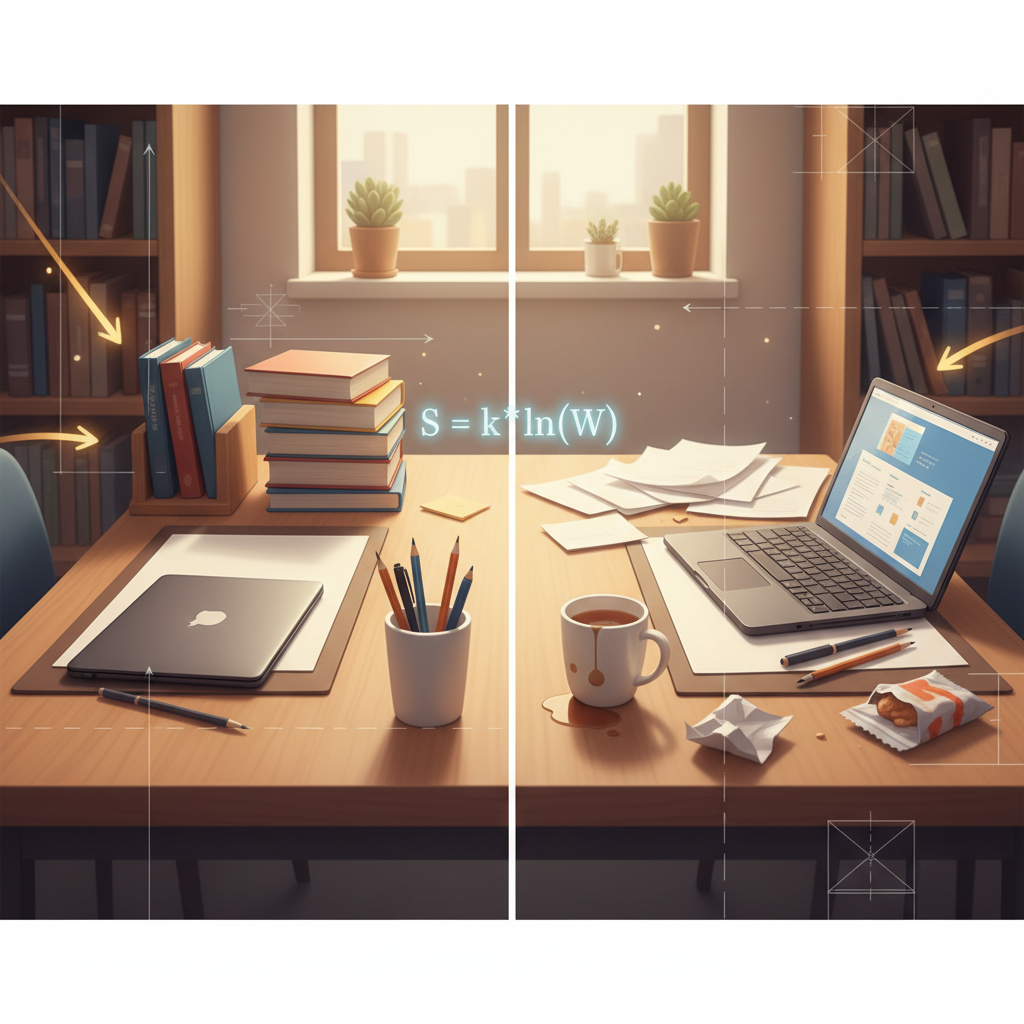
Why Your Desk Gets Messy
You cleaned your desk on Sunday. By Wednesday, it looks like a small hurricane passed through.
You did not decide to make it messy. You did not plan the chaos. You just... lived. You set down your coffee. You left a paper out instead of filing it. You stacked a book on top of another book. Each action was small, reasonable, and perfectly innocent.
And yet: mess.
This happens to your inbox, your kitchen counter, your car, your closet, and your downloads folder. It happens to everyone. It has always happened to everyone. And it is not because people are lazy.
It is because disorder is free.
Why disorder wins by default
Pick up the ten objects on your desk. Close your eyes. Drop them randomly. What are the odds they land in a neat, organized arrangement?
Essentially zero.
There is exactly one arrangement you would call "organized" — or maybe a handful, if you are flexible. But there are thousands of arrangements you would call "messy." The math is not close. Disorder outnumbers order by an absurd margin.
This is not a metaphor for a physics principle. This is the physics principle.
The second law of thermodynamics says that in any closed system, entropy — a measure of how many different microscopic arrangements are compatible with what you see — tends to increase. Not because there is a force pushing things toward mess. But because there are so many more messy states than tidy ones that random changes almost always move you toward disorder.
Your desk is a closed system every time you are not actively tidying it. And random changes — setting things down, shifting piles, adding new objects — almost always increase the number of possible arrangements. Which means they almost always increase entropy.
Mess is not what happens when something goes wrong. Mess is what happens when nothing in particular happens at all.
The energy cost of order
So how does your desk ever get clean?
You clean it. You spend energy — physical effort, attention, time — to move objects from high-entropy arrangements (scattered everywhere) to low-entropy arrangements (books on the shelf, pens in the cup, papers in the folder).
This is not free. It costs you something every time.
And here is the part that stings: it is never done. The moment you stop spending energy, entropy starts winning again. Your desk does not stay clean on its own. It stays clean only as long as you keep paying the energy bill.
In Daily Entropy, we explored how this plays out with socks, drawers, and the general accumulation of stuff. The pattern is always the same: more objects means more possible arrangements, which means more ways to be messy, which means more energy needed to maintain order.
But now let's put some structure on this.
The physics: free energy
Physicists have a precise way to talk about the competition between energy and disorder. It is called free energy, and it looks like this:
Here is what each piece means:
- is the energy of the system — the total effort stored in the current arrangement
- is the temperature — how much random jostling the system experiences (in everyday life, think of this as the rate of random disturbances: people walking by, new tasks arriving, objects being set down)
- is the entropy — the number of ways the system could be rearranged without you noticing a difference
Free energy is what is left over after entropy takes its cut. It is the energy available to do useful work — to keep things organized, to maintain structure, to resist the slide into disorder.
When temperature is low — when disturbances are rare — entropy's cut is small, and most of your energy goes toward maintaining order. This is why your desk stays clean over a quiet weekend.
When temperature is high — when disturbances are frequent — entropy's cut is large, and your energy gets eaten up just coping with the chaos. This is why your desk explodes during a busy work week.
The equation tells you something your intuition already knows: the busier your life, the harder it is to stay organized. That is not a personal failing. It is thermodynamics.
Maintenance is not mass
Here is a subtlety that matters more than it first appears.
When you buy a filing cabinet, you might think the cost is the purchase price — the "mass" of the object, its material and manufacturing cost. But the real cost is the ongoing energy you spend using it: filing things, finding things, reorganizing when categories change.
The purchase price is a one-time payment. The maintenance cost is forever.
In the Epimechanics framework, this distinction is formalized. The generalized mass of a system — its resistance to change — is not the same as its maintenance cost. A heavy, well-built desk (high mass, deep stability basin) might actually cost less to maintain than a cheap, flimsy one (low mass, shallow stability basin), because the well-built desk does not wobble, does not break, does not need constant fiddling.
Mass and maintenance cost are different quantities. Confusing them is one of the most common mistakes in everyday thinking about systems. We will return to this distinction in Why Your House Costs More Than You Think.
The daily negotiation
Every day, you are negotiating with entropy. You cannot win permanently. You can only manage the terms.
The strategies are the ones you already use, whether you know the physics or not:
- Reduce the number of objects (fewer items = fewer possible arrangements = lower entropy ceiling)
- Use uniform objects (identical items are interchangeable, so many arrangements count as "ordered")
- Create structure (shelves, folders, labels reduce the number of accessible states)
- Accept some mess (fighting entropy everywhere costs more energy than it saves)
Every one of these is an entropy-management strategy. You have been doing thermodynamics your whole life. You just did not have the equation.
What this tells you
Your desk gets messy because the universe is wired for disorder. There are astronomically more messy states than tidy ones, and random changes almost always push you toward mess. Cleaning requires energy, and the energy bill never stops.
This is not a flaw in you or in your desk. It is the second law of thermodynamics, operating in the state space of desk arrangements exactly as it operates in the state space of gas molecules. The same equation — — governs both.
Once you see this, you stop blaming yourself for the mess. And you start asking a better question: Where is my energy best spent?
That question — how to allocate finite energy across competing entropy sources — turns out to be one of the deepest questions in physics. And you have been answering it, imperfectly but persistently, every time you decide which pile to tackle first.
This post is part of the Physics of Common Sense series, which builds everyday intuitions toward the formal Epimechanics framework. For more on entropy in daily life, see Daily Entropy. For the formal treatment of free energy and entropy production, see Part 1: Generalized Mechanics.