
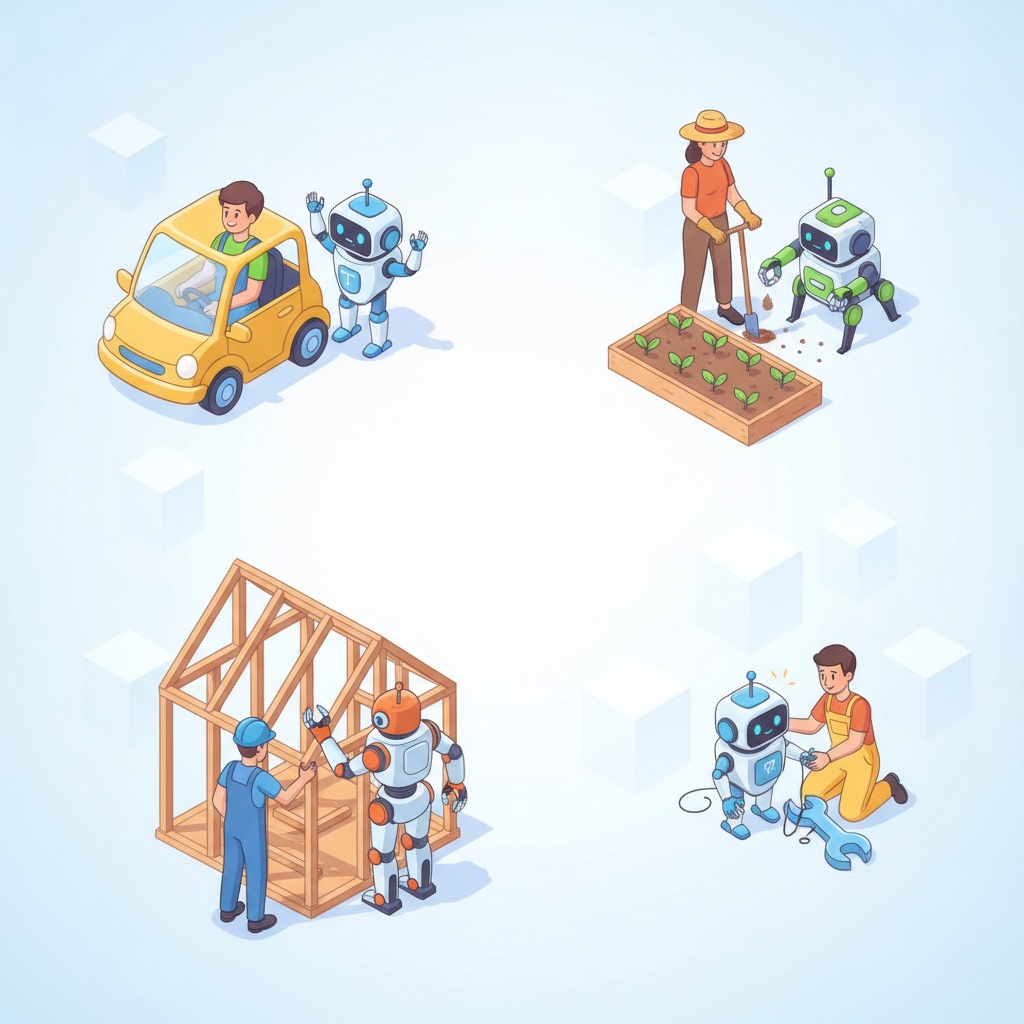
Machines and humans of loving grace will make a greater future possible.
The phrase "machines of loving grace" comes from Richard Brautigan's poem "All Watched Over by Machines of Loving Grace," first published in 1967. Dario Amodei used it in October 2024 as the title of his essay on how AI could make the world better. Machines of loving grace are machines that help people. I want humans of loving grace too. All of Loving Grace means both, working together.
I'm hopeful. The future is limited by what we don't know, the mistakes we might make and the challenges we might face. We can work to find them and fix them. So I'll start with the problems I see and what we do about them.
Problems we face
1. Global warming
The IPCC says human activity has caused global warming, and that the world was 1.1 °C warmer in 2011 to 2020 than in 1850 to 1900 (IPCC, 2023). The WMO found 2024 was the warmest year on record, about 1.55 °C (plus or minus 0.13 °C) above that baseline. It also says one hot year doesn't mean the Paris goal has failed, because that goal is measured over decades (WMO, 2025). If every country meets its pledges, warming this century is projected at 2.3 to 2.5 °C (UNEP Emissions Gap 2025, via PBL).
2. Unstable techno-geopolitics
The rules on who can buy advanced chips keep changing. The US limited China's access to advanced chips in October 2022 (BIS, 2022), and the US announced in May 2025 that it would rescind a January 2025 rule on AI chip sales, four months after it was issued (BIS, 2025). In 2022, all of the world's capacity for the most advanced (under 10 nm) logic chips sat in Taiwan (69%) and South Korea (31%) (SIA and BCG, 2024). SIPRI counted about 12,241 nuclear warheads in January 2025, and it warns that AI that speeds up crisis decisions raises the risk of nuclear war (SIPRI, 2025).
3. Adversarial AI
People attack AI, and they use AI to attack others. Researchers found that automatically generated text made chatbots give harmful answers, and the same text worked on ChatGPT, Bard and Claude (Zou et al., 2023). In another study, 250 poisoned documents were enough to plant a hidden trigger in language models of every size tested (Anthropic, UK AISI and Turing Institute, 2025). Anthropic also reported that a group it believes was backed by the Chinese state used its Claude Code tool against about thirty targets, with AI doing 80 to 90% of the work. Only a small number of the attacks succeeded. That account comes from Anthropic alone (Anthropic, 2025).
4. AI that reduces agency and skill
A Polish study found that doctors who had been using AI found an adenoma in 22.4% of colonoscopies done without it, down from 28.4% before (Budzyń et al., 2025). That study only looked back at records. A later trial in Norway, which followed 5,013 colonoscopies as they happened, found no loss of skill (Pedersen et al., 2026). A study in schools gives a clearer result. Students who used GPT-4 freely scored 17% lower than students who never had it once access was taken away, while a tutor built with safeguards largely removed that harm (Bastani et al., 2025). The FAA warned that constant autopilot use doesn't keep manual flying skills sharp (FAA, 2013).
These four aren't the only risks. The International AI Safety Report 2026 also names misuse for biological and chemical weapons, and loss of control over AI systems (Bengio et al., 2026).
What we do
1. Prevent AI backlash
If people are hurt by AI and nobody helps them, AI gets the blame. In The AI Peace Corps I wrote about what to do: help the people who are affected, with food, jobs, housing and community. People are very important at every stage, so we keep giving back to them. I wrote that when people feel AI helping them, trust builds.
2. Prevent deskilling
When a machine takes over a skill, we start to depend on that machine. The more we depend on it, the more it matters that we can still do the job ourselves.
Surgeons and AI should work together. If the AI can do part of the work better, it should also help teach the surgeon. That way people stay as capable as they can be at the work we approve them to do. The school study above kept students from losing what they learned when the tutor had safeguards.
3. A person can always do what is essential to live
Everyone should keep the basics. Drive a car. Plant food. Build a house. Fix a robot.
Even if a car can drive itself, I'd still like people to learn how to drive. Maybe it becomes a hobby. People keep the skill, so if they ever need it, they have it. The FAA warning about autopilot is the same lesson from the air.
For critical machinery, we need laws that say a person must always be able to take over. I want a control switch, a way for a person to take charge when it matters. It doesn't have to be a kill switch. People should be able to take back control of anything that could end up overpowering their lives.
Distributed Super Intelligence
A kind of general intelligence already exists in organizations of people and computers. AI is growing it into Distributed Super Intelligence (DSI). People are part of DSI, so it's only as good as the people in it.
The danger is Stupid Super Intelligence. It's a system that's very capable at a narrow job and very sure of itself. It causes harm and gains nothing from it. A system can be very capable and still stupid, and that is far more dangerous than a wiser superintelligence that is a little less capable.
Working together
The future is great if we can work together. That includes global warming and unstable geopolitics as well as AI. Machines that help people, and people who keep their skills and their control, can find the problems we face and fix them. That's All of Loving Grace.
Keep reading
- Distributed Super Intelligence: general intelligence already exists in organizations of people and computers; AI is growing it into superintelligence, and it needs oversight, governance and separate parts so no single system takes over.
- Stupid Super Intelligence: The Real Existential Threat: why a capable, overconfident, narrow system is more dangerous than a thoughtful one.
- The AI Peace Corps: helping people with food, jobs, housing and community, before AI gets blamed for everything.
- Humans of Loving Grace: a response to Dario Amodei's essay, on what AI learns from our record of conflict, and how people can give it a better record to learn from.
Sources
- "All Watched Over by Machines of Loving Grace". Wikipedia. Poem by Richard Brautigan, first published 1967. https://en.wikipedia.org/wiki/All_Watched_Over_by_Machines_of_Loving_Grace
- Dario Amodei, "Machines of Loving Grace: How AI Could Transform the World for the Better". darioamodei.com, October 2024. https://darioamodei.com/essay/machines-of-loving-grace
- "AR6 Synthesis Report, Summary for Policymakers". IPCC, March 2023. https://www.ipcc.ch/report/ar6/syr/downloads/report/IPCC_AR6_SYR_SPM.pdf
- "WMO confirms 2024 as warmest year on record at about 1.55°C above pre-industrial level". World Meteorological Organization, 10 January 2025. https://wmo.int/news/media-centre/wmo-confirms-2024-warmest-year-record-about-155degc-above-pre-industrial-level
- "UNEP Emissions Gap report 2025". PBL Netherlands Environmental Assessment Agency, 4 November 2025. https://www.pbl.nl/en/publications/unep-emissions-gap-report-2025
- "Commerce Implements New Export Controls on Advanced Computing and Semiconductor Manufacturing Items to the People's Republic of China (PRC)". US Bureau of Industry and Security, 7 October 2022. https://www.bis.gov/press-release/commerce-implements-new-export-controls-advanced-computing-semiconductor-manufacturing-items-peoples
- "Department of Commerce Rescinds Biden-Era Artificial Intelligence Diffusion Rule, Strengthens Chip-Related Export Controls". US Bureau of Industry and Security, 13 May 2025. https://www.bis.gov/press-release/department-commerce-rescinds-biden-era-artificial-intelligence-diffusion-rule-strengthens-chip-related
- "Emerging Resilience in the Semiconductor Supply Chain". Semiconductor Industry Association and Boston Consulting Group, May 2024. https://www.semiconductors.org/wp-content/uploads/2024/05/Report_Emerging-Resilience-in-the-Semiconductor-Supply-Chain.pdf
- "Nuclear risks grow as new arms race looms: new SIPRI Yearbook out now". Stockholm International Peace Research Institute, 16 June 2025. https://www.sipri.org/media/press-release/2025/nuclear-risks-grow-new-arms-race-looms-new-sipri-yearbook-out-now
- Zou, Wang, Carlini, Nasr, Kolter, Fredrikson, "Universal and Transferable Adversarial Attacks on Aligned Language Models". arXiv, 27 July 2023. https://arxiv.org/abs/2307.15043
- "A small number of samples can poison LLMs of any size". Anthropic, UK AI Security Institute and Alan Turing Institute, 9 October 2025. https://www.anthropic.com/research/small-samples-poison
- "Disrupting the first reported AI-orchestrated cyber espionage campaign". Anthropic, 13 November 2025. https://www.anthropic.com/news/disrupting-AI-espionage
- Budzyń et al., "Endoscopist deskilling risk after exposure to artificial intelligence in colonoscopy: a multicentre, observational study". Lancet Gastroenterology & Hepatology, 12 August 2025. https://wrap.warwick.ac.uk/id/eprint/191005
- Pedersen et al., "Learning and deskilling effects of artificial intelligence in colonoscopy among endoscopists with different levels of experience". Endoscopy, 3 June 2026. https://pubmed.ncbi.nlm.nih.gov/42235541/
- Bastani et al., "Generative AI without guardrails can harm learning: Evidence from high school mathematics". PNAS, 25 June 2025. https://pubmed.ncbi.nlm.nih.gov/40560616/
- "SAFO 13002: Manual Flight Operations". Federal Aviation Administration, 4 January 2013. https://www.faa.gov/sites/faa.gov/files/other_visit/aviation_industry/airline_operators/airline_safety/SAFO13002.pdf
- Yoshua Bengio (chair) et al., "International AI Safety Report 2026". 3 February 2026. https://arxiv.org/pdf/2602.21012